Remote Jobs That Start With D (Salary & Skills)
If you searched for remote jobs that start with D, you’ve probably already scrolled past a few pages that aren’t actually useful — alphabetical job-title directories with no salary data, or “jobs that start with D” roundups that lump dairy farmers and delivery drivers in with data scientists. None of that tells you which “D” careers you can genuinely do from home in 2026.
This guide skips the filler. Every role below made the cut because it’s realistically remote-compatible right now, not because it happens to start with the fourth letter of the alphabet. You’ll find current salary ranges, what each job actually involves day to day, what it takes to break in, and an honest look at how AI is changing some of these roles faster than others.
What Makes a Job “Remote” on This List?
Plenty of “D” jobs sound remote-friendly but aren’t, at least not in practice. Delivery driver, dock worker, and daycare provider all start with D, but none of them can be done from a laptop. To keep this list useful, a role only made the cut if it meets at least one of these conditions:
- The core work product is digital — data, code, designs, written content, or analysis that can be delivered over the internet with no physical presence required.
- Employers are actively posting it as fully remote, not just “remote-eligible” in name only.
- Client or patient interaction happens through virtual tools — video calls, telehealth platforms, or messaging — rather than in person.
That filter is why you won’t see doctor, dentist, or dock supervisor here, even though they’re common in generic “D jobs” lists. It’s also why a few less-obvious picks, like remote dispatcher and video interpreter, made the list even though they don’t scream “remote career” at first glance.
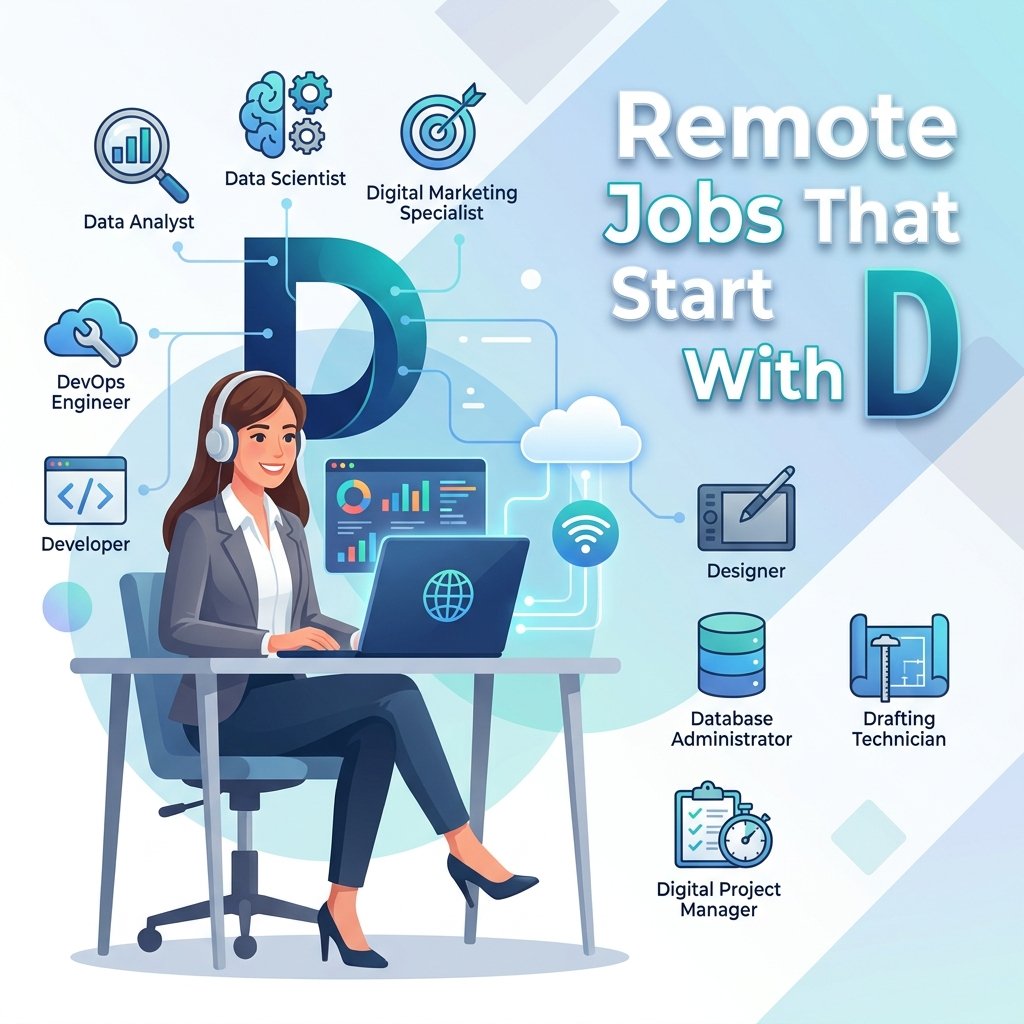
Complete List of Remote Jobs That Start With D
Here’s the full list at a glance. Salary figures reflect typical 2026 US remote pay ranges pulled from Built In, Glassdoor, ZipRecruiter, and BLS data — jump to any section below for the full breakdown.
| Job Title | Typical Remote Salary (US) | Typical Education | Remote-Friendly Level | 2026 Trend |
|---|---|---|---|---|
| Data Analyst | $75,000–$100,000 | Bachelor’s or bootcamp/certificate | Fully remote common | Growing |
| Data Scientist | $100,000–$150,000+ | Bachelor’s/Master’s | Fully remote common | Growing |
| Data Engineer | $110,000–$150,000 | Bachelor’s | Fully remote common | Growing fast |
| Database Administrator | $85,000–$120,000 | Bachelor’s | Fully remote common | Stable |
| Data Entry Specialist / Data Quality Analyst | $33,000–$45,000 (entry) | High school diploma+ | Fully remote common | Shrinking / evolving |
| Software Developer | $111,000–$144,000 | Bachelor’s or bootcamp | Fully remote common | Growing |
| DevOps Engineer | $120,000–$160,000 | Bachelor’s | Fully remote common | Growing fast |
| Digital/Graphic Designer | $50,000–$65,000 | Bachelor’s or strong portfolio | Fully remote common | Stable |
| Digital Product/UX Designer | $75,000–$110,000 | Bachelor’s or bootcamp | Fully remote common | Growing |
| Digital Marketing Manager | $65,000–$100,000 | Bachelor’s | Fully remote common | Growing |
| Dietitian (Telehealth) | $55,000–$95,000 | Bachelor’s + RDN credential | Fully remote common | Growing |
| Dispatcher (Virtual) | $38,000–$55,000 | High school diploma+ | Fully remote common | Stable |
| Document Control Specialist | $45,000–$65,000 | High school diploma/Associate’s | Hybrid common | Stable |
| Debt Collections Specialist | $35,000–$50,000 | High school diploma+ | Fully remote common | Stable |
| Deaf/ASL Interpreter (VRI) | $45,000–$70,000 | Certification (RID) | Fully remote common | Growing |
| Data Privacy & Compliance Analyst | $80,000–$120,000 | Bachelor’s + certification | Hybrid/remote common | Growing fast |
Salary ranges are typical bands, not guarantees. Actual pay depends heavily on experience, industry, and company size.
Remote Jobs That Start With D — Full Breakdowns
Data Analyst
What they do: Data analysts pull raw business data — sales numbers, website traffic, customer records — and turn it into reports and dashboards that help teams make decisions.
Skills needed: SQL, a business intelligence tool like Tableau or Power BI, and increasingly some Python. Clear communication matters just as much as the technical side, since analysts often present findings to non-technical stakeholders.
Education: A bachelor’s degree in a quantitative field is common, though certificate programs and bootcamps have become a realistic alternative entry path for career changers.
Average salary: Remote data analyst pay typically runs $75,000–$100,000, with entry-level roles starting lower and senior analysts in tech or finance clearing $130,000. The closest official government category, operations research analysts, reports a median annual wage in the high $80,000s, according to the BLS Occupational Outlook Handbook.
Remote opportunities: Strong. This is one of the most consistently remote-friendly roles on this list, and demand is expected to keep growing as more companies build out analytics teams.
Who this is best for: People who like solving practical problems with numbers and don’t mind spending most of the day inside spreadsheets and dashboards.
Data Scientist
What they do: Data scientists go a step beyond analysis — building predictive models, running experiments, and applying machine learning to answer questions a standard report can’t.
Skills needed: Python or R, statistics, machine learning fundamentals, and SQL. A portfolio of real projects (even personal ones) carries real weight in hiring.
Education: Typically a bachelor’s degree in a technical field, with many roles preferring a master’s, especially at larger tech companies.
Average salary: Remote data scientist roles commonly pay $100,000–$150,000 or more, with senior and specialized machine learning roles pushing well past that range.
Remote opportunities: Strong, particularly at tech-forward companies that have built fully distributed data teams.
Who this is best for: People with a genuine interest in statistics and machine learning who want to work on harder, more open-ended problems than standard reporting.
Data Engineer
What they do: Data engineers build and maintain the pipelines and infrastructure that move data from one system to another, so analysts and scientists have clean, reliable data to work with.
Skills needed: SQL, Python, cloud platforms (AWS, Azure, or Google Cloud), and familiarity with data pipeline tools.
Education: A bachelor’s degree in computer science or a related field is standard, though strong self-taught engineers with real project experience also break in.
Average salary: Typically $110,000–$150,000 remotely, among the higher-paying roles on this list.
Remote opportunities: Very strong — this is backend, infrastructure-focused work that rarely requires physical presence anywhere.
Who this is best for: People who enjoy systems and architecture more than analysis itself, and who like building things that other teams depend on.
Database Administrator
What they do: Database administrators keep an organization’s databases running, secure, backed up, and performing well, often managing systems that other teams rely on daily.
Skills needed: SQL, familiarity with database platforms (PostgreSQL, MySQL, Oracle, SQL Server), and a strong grasp of data security practices.
Education: A bachelor’s degree in computer science or information systems is typical, along with vendor-specific certifications.
Average salary: Generally $85,000–$120,000 remotely, depending on the platforms and industry involved.
Remote opportunities: Strong. Most database administration work can be done entirely off-site with the right access and monitoring tools.
Who this is best for: Detail-oriented people who like stable, structured systems work over flashier front-end projects.
Data Entry Specialist / Data Quality Analyst
What they do: Traditional data entry involves keying information into systems from forms, invoices, or scanned documents. That version of the job is fading fast — see the AI section below — but it’s evolving into data quality and data cleanup roles that check, correct, and validate data that automated tools have already processed.
Skills needed: Strong attention to detail, spreadsheet fluency, and increasingly, comfort reviewing AI-generated output rather than typing from scratch.
Education: A high school diploma is often enough to start, though moving into a data quality or coordinator role usually benefits from some spreadsheet or SQL training.
Average salary: Traditional data entry pay has dropped to roughly $33,000–$45,000 as demand shrinks, while data quality and oversight roles pay meaningfully more.
Remote opportunities: Very strong, and one of the most searched “work from home” terms — but be selective, since this category also attracts a disproportionate number of scam listings (more on spotting those below).
Who this is best for: People looking for an accessible entry point into remote work who are willing to build toward a data quality or analyst role rather than staying in pure data entry long-term.
Software Developer
What they do: Developers write, test, and maintain the code behind websites, apps, and software systems, working from a spec or product requirement through to a working feature.
Skills needed: Proficiency in at least one programming language (JavaScript, Python, Java, or similar), version control (Git), and problem-solving ability that goes beyond memorized syntax.
Education: A bachelor’s degree in computer science is common but no longer required everywhere — bootcamp graduates and self-taught developers with a solid portfolio regularly land remote roles.
Average salary: Remote software developer pay typically runs $111,000–$144,000, with senior engineers and specialized roles earning considerably more.
Remote opportunities: Excellent. Software development is one of the most mature remote-work categories, with entire engineering teams operating fully distributed.
Who this is best for: Logical thinkers who enjoy building things and don’t mind ongoing learning, since tools and frameworks shift constantly.
DevOps Engineer
What they do: DevOps engineers manage the infrastructure and automation that let development teams ship code reliably — think deployment pipelines, cloud infrastructure, and system monitoring.
Skills needed: Cloud platforms (AWS, Azure, GCP), containerization tools like Docker and Kubernetes, scripting, and a strong grasp of automation.
Education: A bachelor’s degree in computer science or a related field is typical, though cloud certifications carry significant weight in hiring.
Average salary: Among the highest-paying roles here, typically $120,000–$160,000 remotely.
Remote opportunities: Excellent — this work is infrastructure-focused and cloud-based by nature, making it a natural fit for distributed teams.
Who this is best for: People who like automation, systems thinking, and being the one who keeps things running smoothly behind the scenes.
Digital/Graphic Designer
What they do: Digital designers create visual content — logos, marketing graphics, social media assets, and website visuals — for brands and companies.
Skills needed: Adobe Creative Suite (Illustrator, Photoshop), layout and typography fundamentals, and a portfolio that shows range.
Education: A bachelor’s degree in graphic design is common, but a strong portfolio can substitute for formal credentials, especially for freelance work.
Average salary: Remote graphic designer pay commonly falls between $50,000 and $65,000, with senior and specialized designers earning more.
Remote opportunities: Strong, and one of the most freelance-friendly creative roles on this list.
Who this is best for: Visually minded people who enjoy client work and can take direction well while still bringing their own creative judgment.
Digital Product / UX Designer
What they do: UX and digital product designers focus on how software actually works for the people using it — mapping user flows, building wireframes, and testing designs before developers build them.
Skills needed: Figma or similar design tools, user research basics, and the ability to justify design decisions with reasoning, not just aesthetics.
Education: A bachelor’s degree or a UX-focused bootcamp/certificate program, paired with a strong case-study portfolio.
Average salary: Typically $75,000–$110,000 remotely, higher than traditional graphic design due to the product and research component.
Remote opportunities: Strong, particularly at software and SaaS companies that have fully embraced distributed product teams.
Who this is best for: People who like both the creative and analytical sides of design — visuals and the reasoning behind them.
Digital Marketing Manager
What they do: Digital marketing managers plan and run a company’s online marketing — email campaigns, paid ads, SEO strategy, and social media — and track what’s actually working.
Skills needed: Familiarity with ad platforms (Google Ads, Meta), analytics tools, email marketing platforms, and basic content strategy.
Education: A bachelor’s degree in marketing, communications, or business is typical, though a strong track record of results often matters more than the degree itself.
Average salary: Generally $65,000–$100,000 remotely, with senior and specialized roles (like paid media or growth marketing) earning above that range.
Remote opportunities: Strong and growing — marketing and sales roles have been among the fastest-growing categories in recent remote hiring data, discussed further below.
Who this is best for: People who like a mix of strategy, creativity, and data, and who enjoy testing what actually moves the needle rather than just executing a plan.
Dietitian (Telehealth)
What they do: Telehealth dietitians provide nutrition counseling and meal-planning guidance to clients over video calls or messaging platforms, often working with people managing specific health conditions.
Skills needed: Clinical nutrition knowledge, strong communication skills, and comfort using telehealth software and electronic medical records.
Education: A bachelor’s degree in nutrition or dietetics plus the Registered Dietitian Nutritionist (RDN) credential from the Commission on Dietetic Registration is the standard requirement.
Average salary: Typically $55,000–$95,000, with full-time telehealth roles at the higher end of that range depending on caseload and specialty.
Remote opportunities: Strong and growing quickly, as more healthcare has shifted toward telehealth delivery. That said, licensing requirements vary by state, and most roles require you to be licensed in the state where your client is located.
Who this is best for: Licensed dietitians who want flexible hours and a fully virtual caseload instead of an in-person clinical setting.
Dispatcher (Virtual)
What they do: Virtual dispatchers coordinate drivers, delivery routes, or field service technicians remotely, using GPS tracking and communication software rather than working from a physical dispatch center.
Skills needed: Strong multitasking, clear communication under pressure, and comfort with dispatch or fleet-management software.
Education: A high school diploma is typically sufficient, with on-the-job training covering the specific software and workflows.
Average salary: Generally $38,000–$55,000, depending on the industry (trucking, home services, emergency-adjacent dispatch tends to pay more).
Remote opportunities: Solid — many trucking and logistics companies now run dispatch operations fully remotely.
Who this is best for: People who thrive on fast-paced, real-time problem-solving and don’t mind being “on” for structured shift hours.
Document Control Specialist
What they do: Document control specialists manage an organization’s official records and files — version control, formatting standards, approvals, and retrieval — often in regulated industries like construction, engineering, or manufacturing.
Skills needed: Strong organizational skills, attention to detail, and familiarity with document management systems (SharePoint, specialized DMS platforms).
Education: A high school diploma or associate degree is common, sometimes paired with industry-specific certifications.
Average salary: Typically $45,000–$65,000, varying by industry and the complexity of compliance requirements.
Remote opportunities: Good, though this role skews more hybrid than fully remote in regulated industries that still require occasional on-site document handling.
Who this is best for: Highly organized people who like structure, process, and being the person who keeps records accurate and accessible.
Debt Collections Specialist (Remote)
What they do: Remote collections specialists contact customers about overdue accounts, negotiate payment plans, and update account records — all by phone or messaging, from a home office.
Skills needed: Strong communication skills, patience under difficult conversations, and comfort working within compliance rules (like the Fair Debt Collection Practices Act).
Education: A high school diploma is typically enough to start; some employers prefer prior customer service or call-center experience.
Average salary: Generally $35,000–$50,000, sometimes with commission or bonus structures tied to collection rates.
Remote opportunities: Strong — many financial services and BPO companies run fully remote collections teams.
Who this is best for: People with thick skin and strong de-escalation skills who are comfortable with difficult, repetitive phone conversations.
Deaf/ASL Interpreter (Video Remote Interpreting)
What they do: Video remote interpreters (VRI) provide real-time American Sign Language interpretation over video calls, connecting Deaf or hard-of-hearing individuals with hearing callers in settings like healthcare, customer service, or legal calls.
Skills needed: Fluency in ASL and English, fast real-time interpretation ability, and professionalism in sensitive or high-stakes conversations (medical, legal).
Education: Certification through the Registry of Interpreters for the Deaf (RID) or a state-level equivalent is generally required.
Average salary: Typically $45,000–$70,000, with per-minute or hourly contract work also common.
Remote opportunities: Strong and growing — VRI has become one of the most common ways interpreting services are delivered, especially outside major cities.
Who this is best for: Certified interpreters who want more schedule flexibility than traditional in-person interpreting assignments allow.
Data Privacy & Compliance Analyst
What they do: These analysts help organizations follow data protection laws (like GDPR or state-level privacy regulations), running audits, managing data requests, and advising teams on compliant data handling.
Skills needed: Familiarity with privacy regulations, risk assessment, and increasingly, some technical understanding of how data is stored and processed.
Education: A bachelor’s degree in a related field, often paired with a privacy certification such as CIPP (Certified Information Privacy Professional).
Average salary: Typically $80,000–$120,000, reflecting the specialized, high-demand nature of the role.
Remote opportunities: Good, often hybrid at larger enterprises but increasingly fully remote at smaller companies and consultancies.
Who this is best for: Detail-oriented people who enjoy the intersection of policy, risk, and technology rather than pure coding or pure legal work.
How AI Is Reshaping “D” Remote Jobs in 2026
It would be misleading to cover data-related “D” careers in 2026 without addressing AI directly, because it’s pulling two roles on this list in opposite directions.
Traditional data entry is shrinking. Optical character recognition and automated document processing now handle most routine data-keying work that used to require a human typist. That’s reflected in the numbers: traditional data entry pay has dropped in recent years as demand softens, and the roles that remain increasingly involve reviewing and correcting AI output rather than typing from scratch.
Data analysis and engineering are growing, not shrinking. AI tools are automating the repetitive parts of an analyst’s job — cleaning datasets, drafting first-pass reports, writing boilerplate SQL — but that’s freeing analysts to spend more time on interpretation and strategy, which is harder to automate. Employer demand for analysts who understand both the data and the business context behind it has continued climbing rather than falling.
The practical takeaway: if you’re specifically searching for remote data entry work, it’s worth thinking one step ahead. Building basic spreadsheet, SQL, or data-quality skills on top of typing speed puts you in a much more durable position than staying in pure data entry, where the job pool is actively contracting.
Entry-Level Remote Jobs That Start With D
If you’re starting from scratch with no degree and limited experience, a few roles on this list are realistically accessible right now:
- Data entry / data quality roles — the lowest technical barrier to entry, though treat it as a stepping stone rather than a long-term plan given the trends above.
- Virtual dispatcher — trainable on the job, no degree required.
- Debt collections specialist — often hires based on communication skills over credentials.
- Document control specialist — accessible with strong organizational habits, even without a related degree.
- Entry-level data analyst — more competitive, but a certificate program (rather than a full four-year degree) is increasingly a viable path in.
Skills and Certifications Worth Having
Technical Certifications
For the data and tech roles on this list, a handful of certifications carry real weight with employers: CompTIA certifications for IT-adjacent roles, cloud certifications from AWS or Microsoft Azure for DevOps and data engineering, and a data analytics certificate for anyone breaking into analyst work without a traditional degree. O*NET OnLine, a free U.S. Department of Labor resource, lets you search any of these job titles and see the exact skills and credentials employers prioritize for that specific role.
Licensure-Dependent Roles
Two roles on this list aren’t optional when it comes to credentials. Telehealth dietitians need an active RDN credential and, in most cases, licensure in whatever state their client is physically located in. ASL interpreters doing video remote interpreting typically need RID certification or a recognized state equivalent. Skipping this step isn’t just a formality — it’s usually a hard requirement to get hired at all.
How to Find and Land a Legitimate Remote “D” Job
Data entry and virtual assistant searches attract more than their fair share of scam postings, so a little caution goes a long way:
- Never pay for a job. Legitimate employers don’t charge application fees, “training kit” fees, or equipment deposits before you’re hired.
- Verify the company independently. Search the company name plus “reviews” or “scam” before applying, and check that it has a real, verifiable web presence.
- Be skeptical of vague job descriptions. Real postings describe specific tasks and tools. “Earn $500/day, no experience needed” is a red flag, not a selling point.
- Use established job boards for remote work specifically, rather than generic classifieds, since they tend to vet employers more carefully.
- Tailor your resume to the exact skills listed in the posting, using the employer’s own terminology where it honestly reflects your experience — this matters even more for remote roles, since applicant tracking systems scan for those exact terms before a human ever sees your resume. If you’re building out that skills section, this guide to resume skills that start with P walks through how to choose and phrase skills employers are actually searching for.
Remote Work Trends Shaping These Careers in 2026
A few broader shifts are worth knowing if you’re planning a remote job search this year.
According to FlexJobs’ Q1 2026 Remote Work Index, remote hiring is increasingly concentrated among large, established employers rather than startups, and sales and business development roles have shown some of the strongest growth in remote postings — a reminder that remote work isn’t just a tech-industry story anymore, even on a list this data- and tech-heavy.
At the same time, Robert Half’s Q1 2026 research shows remote and hybrid availability still varies a lot by field. Technology roles report the highest combined hybrid-and-remote share, while healthcare and administrative support roles remain more on-site overall — which tracks with why telehealth dietitian roles specifically call out virtual delivery, rather than remote work being assumed across all healthcare jobs.
The pattern across both reports is consistent: remote work in 2026 is maturing and spreading beyond tech, but it’s still uneven by field, which is exactly why a filtered, role-by-role list like this one is more useful than a generic alphabetical directory.
Whichever role fits your background and goals, the roles above are the ones actually hiring remotely this year, not just the ones that happen to start with the right letter. If you’re curious how this same filtered approach plays out for a completely different letter, our guide to creative careers that start with G applies the same standard to design, writing, and art-based careers — and if you want to dig into how AI tools specifically are reshaping remote work across industries, our roundup of AI tools that start with A is a useful next stop.
If you’ve ever browsed a job board alphabetically, or you’re just trying to narrow down a career switch, you’ve probably landed on the same question: what are the actual remote jobs that start with D — and which ones are worth pursuing in 2026?
It turns out the letter D covers a surprisingly deep slice of the remote job market. Data roles, design roles, developer roles, and digital marketing roles all start with D, and together they make up some of the highest-demand remote work categories right now. In this guide, you’ll get a real list (not just an alphabetical scrape), 2026 salary ranges pulled from multiple sources, the skills and certifications each role actually requires, and a straightforward plan for landing one of these jobs — plus an honest look at which “D” jobs don’t work remotely, so you don’t waste time chasing the wrong ones.
Quick-Answer List: Remote Jobs That Start With D
Here’s the short version. Each of these has genuine remote or remote-eligible listings as of 2026, and we’ll break down the details on all of them below.
- Data Analyst
- Data Scientist
- Data Entry Clerk / Specialist
- Data Engineer
- Database Administrator
- Developer (Software, Web, App, Front-End, Back-End)
- DevOps Engineer
- Designer (Graphic Designer)
- Designer (UX/UI Designer)
- Digital Marketing Manager
- Digital Marketing Specialist
- Digital Content Strategist
- Dispatcher (partially remote / hybrid-remote)
- Document Controller / Documentation Specialist
- Debt Collector (remote collections agent)
- Diversity & Inclusion Specialist
A few of these are fully remote almost everywhere they’re posted (Developer, Data Scientist, Designer). Others, like Dispatcher, are more often hybrid or “remote-eligible” depending on the employer. We’ll flag that distinction as we go, because it matters for how realistic your search will be.
How We Verified These Jobs Are Actually Remote
Alphabetical job-title directories are useful for one thing: alphabetizing. They don’t tell you whether a job is actually done from home, whether it pays a living wage, or whether it’s currently in demand. So before including anything on this list, we cross-checked it against a few things:
- Whether the role shows up regularly on dedicated remote job boards like We Work Remotely and FlexJobs
- Whether the U.S. Bureau of Labor Statistics or O*NET classifies it as a role with meaningful remote/telework potential
- Whether multiple independent salary sources (not just one aggregator) report consistent, current figures
That last point matters more than it sounds. Salary aggregators don’t always agree with each other, and we’ll be upfront about that throughout this article rather than presenting a single number as gospel.
Data-Focused Remote Jobs Starting With D
Data roles are the backbone of this list. They’re some of the most naturally remote-friendly jobs that exist, since the work — pulling, cleaning, modeling, and interpreting data — rarely requires being in a physical office.
Data Analyst
A data analyst takes raw business data and turns it into something a company can actually act on: sales trends, customer behavior, operational bottlenecks. It’s one of the more accessible entry points into the data field, since many analysts come in with a bachelor’s degree in a related field plus hands-on experience with SQL, Excel, and a visualization tool like Tableau or Power BI.
Salary estimates vary depending on the source, which is worth knowing before you negotiate. Aggregator averages for remote data analyst roles in 2026 generally land somewhere between $75,000 and $91,000 a year, with entry-level positions starting lower — often in the mid-$50,000s to mid-$60,000s. For a government-backed baseline, the Bureau of Labor Statistics’ Occupational Outlook Handbook tracks the closest matching occupation, Operations Research Analysts, at a median annual wage of $90,440 as of its most recent published data.
Common tools and skills: SQL, Excel, Tableau or Power BI, basic statistics, and increasingly, familiarity with AI-assisted analytics platforms. If you’re building this skill set from scratch, it’s worth looking at AI platforms built for online skill-building, since several now offer structured, self-paced tracks specifically for data analysis fundamentals.
Data Scientist
Data scientists go a step further than analysts — they build predictive models, apply machine learning, and often need a stronger statistics or computer science background, frequently at the master’s level for competitive roles. This is one of the higher-paying jobs on this entire list.
Remote data scientist salaries in 2026 tend to average somewhere in the $110,000 to $160,000 range depending on the source and experience level, with junior remote roles starting closer to $97,000–$105,000 and senior remote roles climbing well past $160,000 with bonuses and equity factored in.
What moves the needle on pay: Python proficiency, SQL, and real-world modeling experience are consistently cited as the biggest differentiators. If you’re trying to figure out which data tools are actually being used in industry right now, AI analytics tools built for small businesses in 2026 is a useful reference point — a lot of the platforms companies use to make data decisions overlap directly with what data scientists are expected to know.
Data Entry Clerk / Data Entry Specialist
This is the most accessible data role on the list, and it’s genuinely one of the easiest remote jobs to land without a degree or specialized background. The tradeoff is pay: remote data entry clerk salaries in 2026 average roughly $40,000 to $45,000 a year, with a typical range from the mid-$30,000s up to about $51,000 for more senior or specialized data entry work (payroll or accounting-focused entry roles tend to sit at the higher end).
It’s worth being clear-eyed here: this field has been under some wage pressure as automation tools take over more repetitive entry tasks, so it’s often better viewed as a starting point or a flexible side income rather than a long-term ceiling.
Data Engineer
Data engineers build and maintain the infrastructure that data analysts and scientists rely on — pipelines, databases, and systems that move data around reliably. It’s a more technical, engineering-adjacent role that typically requires programming experience (often Python, SQL, and familiarity with cloud platforms).
Database Administrator
A database administrator (DBA) keeps a company’s databases running, secure, and properly backed up. It’s less flashy than data science but consistently in demand, especially in industries with strict data governance requirements like healthcare and finance. Vendor-specific certifications (from major cloud and database providers) can meaningfully boost hiring prospects here.
| Role | What They Actually Do | Typical Entry Point | Remote Availability |
|---|---|---|---|
| Data Analyst | Turns raw data into business insights | Bachelor’s degree + SQL/Excel skills | High |
| Data Scientist | Builds predictive models and ML systems | Bachelor’s or master’s + Python/stats | High |
| Data Engineer | Builds the pipelines data analysts and scientists use | Bachelor’s + programming experience | High |
| Data Entry Clerk | Inputs and organizes data manually | No degree required | High (but lower pay ceiling) |
| Database Administrator | Maintains and secures databases | Bachelor’s + certifications | Moderate to High |
Development & Tech Remote Jobs Starting With D
Developer (Software, Web, App, Front-End, Back-End)
“Developer” covers a lot of ground, but it’s consistently one of the largest remote job categories that exists. Software development and engineering roles make up the single largest volume of fully remote job postings tracked across major remote job platforms in 2026.
Pay varies significantly by specialization and experience. Composite 2026 data puts remote software developer salaries somewhere between $100,000 and $150,000 on average, though the full range across experience levels and tech stacks spans much wider — roughly $67,000 for junior roles up to $220,000+ for senior engineers at larger companies. Entry-level remote developer roles average closer to $100,000, though that number includes a wide spread depending on location adjustments and company size.
What matters most for pay: your tech stack, not just your years of experience. A developer who knows an in-demand language or framework can often out-earn someone with more general experience but an outdated skill set.
DevOps Engineer
DevOps engineers sit at the intersection of software development and IT operations, automating deployment pipelines and keeping systems reliable. It’s a strongly remote-compatible role, since the work is almost entirely done through code and cloud infrastructure rather than in-person collaboration.
Design Remote Jobs Starting With D
Designer (Graphic Designer)
Graphic designers create visual content — branding, marketing materials, social assets — and it’s a role that’s long been remote-friendly, since deliverables are digital files that can be reviewed and approved asynchronously.
Designer (UX/UI Designer)
UX and UI designers focus on how digital products look, feel, and function. This specialization typically pays more than general graphic design, and demand has stayed strong as more companies invest in product experience. A strong portfolio built in a tool like Figma tends to matter more than formal credentials for landing interviews.
Design salaries vary widely by specialization — graphic design skews lower than UX/UI work — so it’s worth researching pay specifically for the design discipline you’re targeting rather than treating “designer” as one uniform salary bracket.
Marketing & Digital Remote Jobs Starting With D
Digital Marketing Manager
Digital marketing managers own a company’s overall online marketing strategy — paid ads, SEO, email, social, and everything in between. It’s a role with genuinely wide salary variation depending on industry and company size.
Composite 2026 data puts remote digital marketing manager salaries somewhere in the $88,000 to $127,000 range on average, with entry-level marketing roles starting significantly lower, often in the $55,000–$75,000 band.
Digital Marketing Specialist
A step below the manager level, digital marketing specialists execute the day-to-day work — running campaigns, managing content calendars, tracking analytics. It’s a common entry point into the marketing field and one of the more available remote roles for people without years of prior experience.
Digital Content Strategist
Content strategists plan what content a brand publishes and why, tying it back to SEO and business goals. It overlaps heavily with digital marketing but leans more toward planning and less toward execution.
A practical note for anyone in marketing roles: if your day-to-day involves managing a high volume of client or team emails, tools like AI email assistants built to save hours per week — and specifically an AI email reply generator — are increasingly part of how remote marketing teams stay responsive without burning out on inbox management.
Operations, Admin & Support Remote Jobs Starting With D
Dispatcher
This is one of the more nuanced entries on this list. Dispatching — coordinating drivers, technicians, or emergency responders — has traditionally been an in-office or on-site role, but a growing number of trucking, logistics, and non-emergency dispatch positions now offer remote or hybrid-remote arrangements, since the job mostly involves phone, radio, and software-based coordination. That said, fully remote dispatcher listings are less common than for the data or tech roles above, so treat this as remote-eligible rather than guaranteed remote.
Document Controller / Documentation Specialist
Document controllers manage version control, formatting, and compliance for company documents — common in construction, engineering, and regulated industries. Documentation specialists handle similar work in a broader range of industries, often including technical writing. These roles are increasingly offered remotely, particularly where document management has moved to cloud-based systems.
Debt Collector (Remote Collections Agent)
Remote collections work has grown alongside the broader shift toward remote call-center and customer contact roles. It typically requires strong communication skills and, depending on the state, may require specific licensing.
Diversity & Inclusion Specialist
D&I specialists work within HR to build and support inclusive hiring, training, and workplace culture initiatives. It’s often hybrid or remote-eligible, particularly at companies with distributed workforces where DEI programming already has to be built for a remote-first audience.
Jobs Starting With D That Are NOT Typically Remote
In the interest of being straightforward: not everything that starts with D can be done from your kitchen table. Roles like Dentist, Dermatologist, Doctor, and Driver all start with D and show up constantly in alphabetical job-title lists, but they require physical presence by definition. If you’re specifically hunting for remote work, it’s worth skipping past these rather than wasting application time.
How to Land a Remote “D” Job in 2026
Once you know which role you’re targeting, the process looks fairly similar across all of them:
- Build the specific skill set the role requires — not a generic resume update. For data roles, that means SQL and a visualization tool at minimum. For developer roles, it means picking a stack and going deep rather than staying broad.
- Get a credential or certification where it actually matters. CareerOneStop’s certification finder, run by the U.S. Department of Labor, is a solid, free starting point for figuring out which certifications are recognized in your target field.
- Search on platforms built specifically for remote roles, rather than relying only on general job boards. FlexJobs vets its listings, and We Work Remotely has long been one of the most active boards for tech, design, and marketing roles specifically.
- Use O*NET or the Indeed Career Guide to sanity-check salary expectations before you negotiate, so you’re not anchoring to a single, possibly inflated number from one aggregator.
- Tailor your application to remote-specific expectations. Remote employers often care more about your ability to communicate asynchronously and manage your own time than they do about a polished in-office presentation style — make that visible in how you write your cover letter and answer interview questions.
A common mistake: applying broadly to “remote jobs” without narrowing to a specific role and skill set first. Remote postings, especially for data entry and marketing specialist roles, can pull hundreds of applicants within days. A generic application gets lost. A targeted one, built around a specific tool or certification mentioned in the job posting, stands out.
Salary Comparison Table: Remote Jobs That Start With D (2026)
| Role | Typical Remote Salary Range | Entry-Level Range | Remote Availability |
|---|---|---|---|
| Data Analyst | ~$75,000–$91,000 | ~$55,000–$65,000 | High |
| Data Scientist | ~$110,000–$160,000 | ~$97,000–$105,000 | High |
| Data Entry Clerk | ~$40,000–$45,000 | ~$35,000–$39,000 | High (lower pay ceiling) |
| Data Engineer | Comparable to or above Data Analyst; varies by employer | Varies | High |
| Database Administrator | Varies by industry and certification level | Varies | Moderate to High |
| Software Developer | ~$100,000–$150,000 | ~$65,000–$100,000 | High |
| DevOps Engineer | Comparable to or above Software Developer | Varies | High |
| Graphic Designer | Lower end of the design pay scale | Varies | High |
| UX/UI Designer | Higher end of the design pay scale | Varies | High |
| Digital Marketing Manager | ~$88,000–$127,000 | ~$55,000–$75,000 | High |
| Digital Marketing Specialist | Below manager-level pay | Entry-friendly | High |
| Dispatcher | Composite estimate; verify with current listings | Composite estimate | Moderate (often hybrid) |
| Document Controller | Composite estimate; verify with current listings | Composite estimate | Moderate |
A note on this table: the ranges above reflect a composite of multiple 2026 salary sources (Glassdoor, ZipRecruiter, Built In, and BLS/O*NET where available), which don’t always agree with each other. Where sources diverged significantly, we leaned toward the more conservative estimate. Figures for Dispatcher and Document Controller are broader composite estimates, since dedicated remote-specific salary data was limited at the time of research — check current listings on FlexJobs or We Work Remotely for the most up-to-date numbers before negotiating.
Frequently Asked Questions
What is the highest-paying remote job that starts with D?
Among the roles covered here, Data Scientist and Software Developer consistently rank as the highest-paying, with average remote salaries in the $110,000–$160,000+ range depending on experience and specialization. Senior-level roles in either field can climb well past $200,000 with bonuses and equity.
Can beginners get a remote data entry job with no experience?
Yes — data entry is one of the more accessible remote roles and typically doesn’t require a degree. Pay is modest (averaging around $40,000–$45,000 a year in 2026), so it’s often best approached as an entry point or supplemental income rather than a long-term career ceiling.
Is Dispatcher a remote job?
It depends on the employer and industry. Some trucking, logistics, and non-emergency dispatch roles now offer remote or hybrid arrangements, but fully remote dispatcher listings are less common than for data or tech roles. Check individual job postings carefully rather than assuming remote availability.
What certifications help for remote data jobs?
For data analysts and scientists, practical skill certifications in SQL, Python, and tools like Tableau or Power BI tend to matter more than broad academic credentials. CareerOneStop’s certification finder is a good free resource for identifying recognized certifications by field.
Are remote “D” jobs legitimate, or should I watch for scams?
Most of the roles on this list are entirely legitimate and represent real hiring categories, but remote job scams do exist — especially around data entry and virtual assistant postings that promise unusually high pay for minimal work. Sticking to established platforms like FlexJobs and We Work Remotely, which vet listings, is one of the simplest ways to reduce that risk.
Conclusion
The letter D covers more remote-friendly ground than most job seekers realize — data, design, development, and digital marketing all sit under it, alongside a handful of admin and operations roles that are increasingly remote-eligible. The key isn’t just finding a job title that starts with D; it’s matching your existing skills (or the ones you’re willing to build) to a role with genuine remote demand and a salary range that makes sense for your situation.
If you’re just starting out, data entry or a digital marketing specialist role can be a realistic entry point. If you’re further along in your career, data science, software development, and UX design consistently offer the strongest combination of remote availability and pay. Whichever direction you go, start with the specific skills the role requires, verify salary expectations against more than one source, and search on platforms built specifically for remote hiring rather than general directories — it’ll save you time and get you in front of the roles that are actually worth applying to.