Easy Skills That Start With P for Your Resume (+ Examples)
If you’re staring at a blank skills section and searching for skills that start with P for your resume, you’re not alone. The letter P happens to cover some of the most in-demand abilities in the modern workplace — from problem solving and project management to prioritization and persuasion. The tricky part isn’t finding words that start with P. It’s knowing which ones actually belong on your resume, what they mean in a professional context, and how to prove you have them.
That last part matters more than ever. Hiring in 2026 has shifted toward skills-first evaluation, meaning employers and their applicant tracking systems (ATS) are scanning resumes for specific, provable competencies rather than job titles alone. A resume that lists the right skills — clearly and honestly — has a real advantage over one that relies on vague descriptions or outdated buzzwords.
In this guide, you’ll find a complete list of skills that start with P for your resume, along with plain-English definitions, why employers care about each one, the types of jobs that need it, and real examples of how to phrase it on your resume. By the end, you’ll be able to build a skills section that’s specific, credible, and tailored to the job you actually want.
What Are Resume Skills?
Resume skills are the specific abilities, knowledge areas, and personal strengths you bring to a job. They’re usually grouped into two categories:
- Hard skills are teachable, measurable abilities — things like programming, procurement, or predictive analytics. You can typically point to a class, certification, or project where you learned them.
- Soft skills are interpersonal and behavioral strengths — things like patience, persuasion, or people management. They’re harder to quantify but just as important to how you actually perform on the job.
A strong resume usually blends both. Hard skills show a recruiter you can technically do the job. Soft skills show them you can do it well, alongside other people, under real-world pressure.
Most resumes present skills in a dedicated “Skills” or “Core Competencies” section near the top of the document, but the strongest resumes also weave skills into the work experience section, where they can be backed up with results.
Why Skills Matter on a Resume
It’s tempting to think a resume is mostly about job titles and years of experience. In practice, skills are doing a lot of the heavy lifting — both with human readers and with software.
Applicant tracking systems scan for skill keywords. Before a recruiter ever sees your resume, many companies run it through an ATS that searches for specific terms from the job posting. If your resume doesn’t include the skills the employer is looking for — in the language they use — you may never make it to a human reviewer.
Recruiters skim, they don’t read. Studies on recruiter behavior consistently show that hiring managers spend just seconds on an initial resume scan. A clear, well-organized skills section lets them quickly confirm you’re qualified before they commit to reading further.
Employers increasingly hire for skills, not just credentials. Skills-based hiring has been one of the defining shifts in recruiting, with many employers now prioritizing what a candidate can actually do over degrees or job titles alone. That means the skills you list — and how well you can back them up — carry more weight than ever.
The U.S. Bureau of Labor Statistics Occupational Outlook Handbook is a useful place to check which skills are considered essential for a given occupation, since it’s updated with current labor market data rather than opinion.
How to Choose the Right Skills for Your Industry
Not every skill that starts with P belongs on every resume. Here’s how to narrow the list down to what actually helps you:
- Start with the job description. Highlight every skill word the employer uses. If they say “prioritization,” use that exact term rather than a synonym like “time management,” since ATS software often matches literal keywords.
- Be honest about what you can prove. Only list a skill if you could talk about a specific example of using it in an interview.
- Balance hard and soft skills. A resume full of only soft skills can feel vague. A resume full of only hard skills can feel robotic. Aim for a mix.
- Prioritize relevance over quantity. A focused list of 8–12 skills that clearly match the role usually outperforms a crowded list of 20+ generic ones.
- Check occupational skill databases. Tools like O*NET OnLine, a free U.S. Department of Labor resource, let you search any job title and see which skills employers in that field actually prioritize.
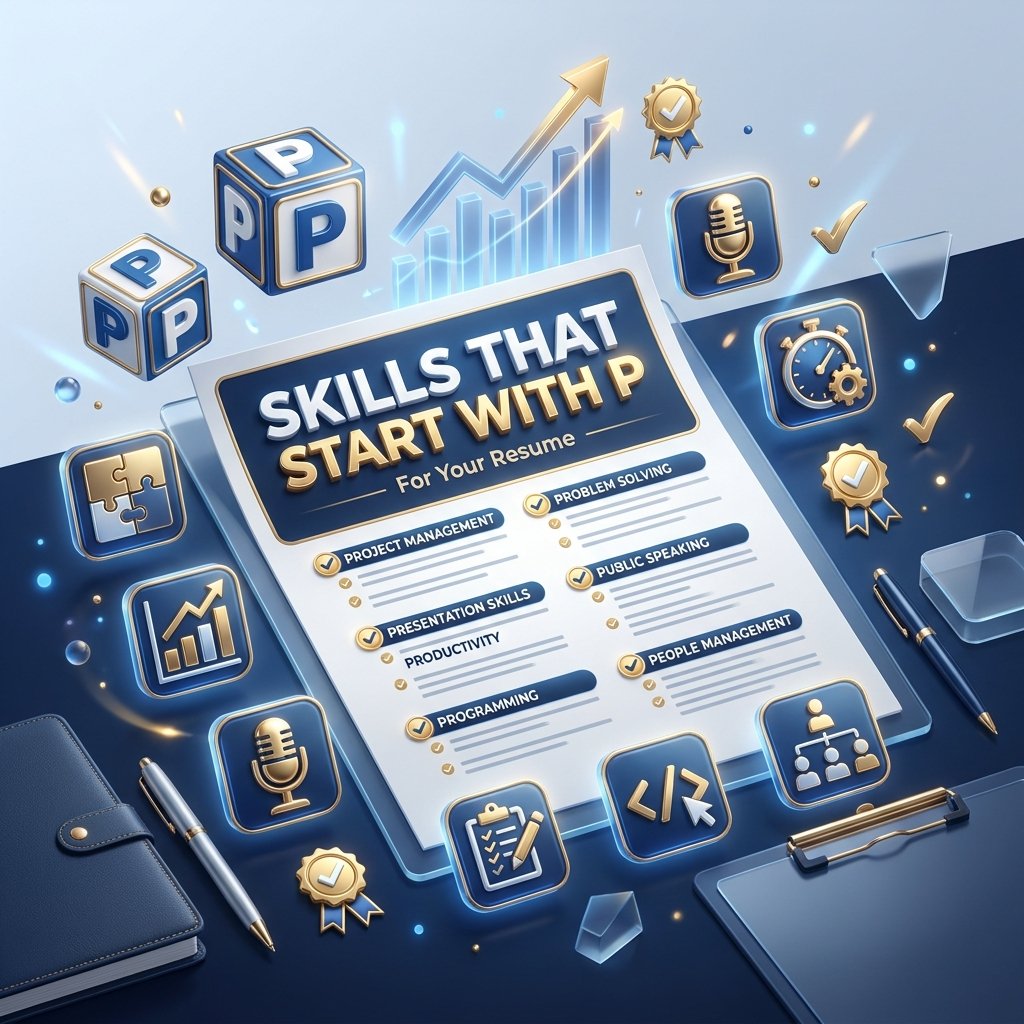
List of Skills That Start With P for Your Resume
| Skill | Definition | Best For |
|---|---|---|
| Problem Solving | Identifying and resolving issues effectively | Engineering, IT, healthcare, management |
| Project Management | Planning and overseeing tasks to completion | Construction, marketing, software, operations |
| Presentation Skills | Communicating information clearly to an audience | Sales, education, consulting |
| Planning | Mapping out goals, steps, and timelines | Operations, logistics, administration |
| Productivity | Producing consistent, efficient, quality output | Most roles, especially remote/high-volume |
| Programming | Writing and maintaining code | Software engineering, data, IT |
| Public Speaking | Speaking confidently to a group | Teaching, sales, leadership |
| Patience | Staying calm through slow or frustrating tasks | Customer service, healthcare, teaching |
| Persuasion | Influencing decisions through reasoning | Sales, marketing, law |
| Prioritization | Deciding what to tackle first | Project management, admin, healthcare |
| Process Improvement | Redesigning workflows for efficiency | Operations, business analysis |
| Procurement | Sourcing and purchasing goods/services | Supply chain, manufacturing |
| Partnership Building | Building productive external relationships | Business development, nonprofit |
| Performance Management | Setting expectations and tracking progress | HR, team leadership |
| Proofreading | Reviewing written material for errors | Editorial, marketing, legal |
| Prospecting | Finding and reaching new potential clients | Sales, real estate, recruiting |
| Predictive Analytics | Forecasting outcomes using data | Data analysis, finance, marketing |
| Policy Development | Drafting organizational guidelines | HR, government, compliance |
| People Management | Supervising and developing employees | Team leadership, retail, hospitality |
| Process Optimization | Fine-tuning processes for efficiency | Manufacturing, logistics, IT |
See the full Markdown version above for detailed definitions, employer value, related jobs, and resume examples for each skill.
Problem Solving
Definition: The ability to identify an issue, evaluate possible solutions, and choose the most effective one.
Why employers value it: Every role runs into unexpected obstacles. Employers want people who can handle those moments without needing constant supervision.
Jobs that need this skill: Engineering, customer service, management, healthcare, IT support.
Resume example: “Resolved recurring shipping delays by redesigning the vendor approval process, cutting average delivery time by 30%.”
Project Management
Definition: Planning, organizing, and overseeing tasks, resources, and timelines to complete a specific goal.
Why employers value it: It shows you can take an idea from start to finish without things falling through the cracks.
Jobs that need this skill: Construction, marketing, software development, event planning, operations.
Resume example: “Managed a cross-functional team of 8 to deliver a product launch two weeks ahead of schedule and under budget.”
Presentation Skills
Definition: The ability to clearly communicate information to an audience, whether in person or virtually.
Why employers value it: Strong presenters can pitch ideas, train colleagues, and represent the company to clients with confidence.
Jobs that need this skill: Sales, education, consulting, marketing, executive roles.
Resume example: “Delivered quarterly performance presentations to senior leadership, translating complex data into clear business recommendations.”
Planning
Definition: The ability to set goals and map out the steps, resources, and timeline needed to reach them.
Why employers value it: Good planners prevent costly last-minute scrambles and keep teams aligned on priorities.
Jobs that need this skill: Operations, logistics, event coordination, administration, project management.
Resume example: “Developed a 6-month staffing plan that reduced overtime costs by 18%.”
Productivity
Definition: The ability to produce consistent, high-quality output efficiently, without sacrificing accuracy.
Why employers value it: Productive employees get more done with the same resources, which directly affects a team’s bottom line.
Jobs that need this skill: Nearly every role, especially remote and high-volume positions like customer support or data entry.
Resume example: “Increased daily ticket resolution rate by 25% by streamlining internal workflows.”
Programming
Definition: Writing, testing, and maintaining code to build software, applications, or automated systems.
Why employers value it: Programming skills are foundational to nearly every modern industry, not just tech companies.
Jobs that need this skill: Software engineering, data science, web development, IT, automation roles.
Resume example: “Built an internal Python tool that automated weekly reporting, saving the team roughly 6 hours per week.”
If you’re exploring the broader tech skills landscape, it’s also worth knowing about the growing category of AI tools that start with A, since familiarity with AI-assisted development tools is increasingly listed alongside traditional programming skills.
Public Speaking
Definition: The ability to speak confidently and clearly in front of a group.
Why employers value it: It signals confidence, preparation, and the ability to influence or inform an audience — valuable well beyond formal presentations.
Jobs that need this skill: Teaching, sales, law, PR, leadership roles.
Resume example: “Hosted monthly all-hands meetings for a 40-person department, improving cross-team communication scores by 15%.”
Patience
Definition: The ability to stay calm and composed while working through slow, repetitive, or frustrating situations.
Why employers value it: Patience prevents small conflicts from escalating and keeps quality high even under pressure.
Jobs that need this skill: Customer service, healthcare, teaching, childcare, technical support.
Resume example: “Provided calm, step-by-step troubleshooting support to non-technical customers, maintaining a 95% satisfaction rating.”
Persuasion
Definition: The ability to influence someone’s thinking or decisions through clear, credible reasoning.
Why employers value it: Persuasion drives sales, negotiations, buy-in from stakeholders, and successful pitches.
Jobs that need this skill: Sales, marketing, fundraising, law, consulting.
Resume example: “Persuaded three key accounts to upgrade service tiers, generating an additional $45,000 in annual revenue.”
Prioritization
Definition: The ability to decide what to tackle first based on urgency, impact, and available time.
Why employers value it: Prioritization keeps important work from getting buried under busywork, especially in fast-paced environments.
Jobs that need this skill: Project management, administrative roles, healthcare, customer support, executive assistance.
Resume example: “Prioritized and triaged over 50 daily support requests, ensuring critical issues were resolved within 1 hour.”
Process Improvement
Definition: Identifying inefficiencies in a workflow and redesigning it to be faster, cheaper, or more reliable.
Why employers value it: Process improvement directly saves companies time and money, which makes it one of the more resume-worthy hard skills.
Jobs that need this skill: Operations, manufacturing, business analysis, healthcare administration, logistics.
Resume example: “Redesigned the client onboarding process, reducing average setup time from 5 days to 2.”
Procurement
Definition: Sourcing, negotiating, and purchasing the goods or services a business needs to operate.
Why employers value it: Skilled procurement professionals control costs and reduce supply chain risk.
Jobs that need this skill: Supply chain, operations, manufacturing, hospitality, government contracting.
Resume example: “Negotiated new vendor contracts that reduced annual procurement costs by 12%.”
Partnership Building
Definition: Developing and maintaining productive working relationships with other companies, departments, or individuals.
Why employers value it: Strong partnerships can open new revenue streams, resources, or opportunities that wouldn’t exist otherwise.
Jobs that need this skill: Business development, nonprofit management, sales, marketing, executive leadership.
Resume example: “Built partnerships with 5 regional organizations to co-host community events, expanding program reach by 40%.”
Performance Management
Definition: Setting expectations, tracking progress, and providing feedback to help employees or teams meet goals.
Why employers value it: It’s central to keeping teams accountable and productive over time.
Jobs that need this skill: Human resources, team leadership, operations management, education administration.
Resume example: “Implemented a quarterly performance review process that improved team goal completion by 20%.”
Proofreading
Definition: Carefully reviewing written material to catch spelling, grammar, and formatting errors before it’s published or sent.
Why employers value it: Clean, error-free communication reflects professionalism and protects a company’s reputation.
Jobs that need this skill: Editorial roles, marketing, administrative support, legal, publishing.
Resume example: “Proofread all outgoing client proposals, reducing formatting errors reported by clients to near zero.”
Prospecting
Definition: Identifying and reaching out to potential customers or clients to generate new business.
Why employers value it: Prospecting fuels the top of the sales funnel — without it, sales teams run out of leads.
Jobs that need this skill: Sales, business development, real estate, insurance, recruiting.
Resume example: “Prospected and qualified over 100 new leads per month, contributing to a 22% increase in pipeline value.”
Predictive Analytics
Definition: Using historical data and statistical models to forecast future outcomes or trends.
Why employers value it: It helps businesses make proactive decisions instead of reactive ones, from inventory planning to customer retention.
Jobs that need this skill: Data analysis, marketing, finance, operations, healthcare planning.
Resume example: “Built a predictive analytics model that forecasted customer churn with 85% accuracy, informing targeted retention campaigns.”
Policy Development
Definition: Researching, drafting, and implementing formal guidelines that govern how an organization operates.
Why employers value it: Clear policies reduce risk, ensure compliance, and create consistency across an organization.
Jobs that need this skill: Human resources, government, compliance, nonprofit leadership, healthcare administration.
Resume example: “Drafted and implemented a remote work policy adopted company-wide, improving employee satisfaction scores by 18%.”
People Management
Definition: Supervising, supporting, and developing employees to help them succeed in their roles.
Why employers value it: Good people managers reduce turnover, boost morale, and get more out of their teams.
Jobs that need this skill: Team leadership, retail management, healthcare supervision, hospitality management.
Resume example: “Managed a team of 12 sales associates, reducing turnover by 25% through structured coaching and feedback.”
Process Optimization
Definition: Fine-tuning an existing process to maximize output, quality, or efficiency, often using data.
Why employers value it: Optimization work delivers measurable savings and performance gains, which are easy to quantify on a resume.
Jobs that need this skill: Manufacturing, logistics, operations analysis, IT systems management.
Resume example: “Optimized the warehouse picking process using route analysis, cutting average fulfillment time by 15%.”
Best Skills for Different Careers
Different roles lean on different “P” skills. Use this table as a quick reference when tailoring your resume.
| Career Field | Most Relevant P Skills |
|---|---|
| Business & Management | Project Management, Planning, Prioritization, Performance Management |
| Sales & Business Development | Persuasion, Prospecting, Partnership Building, Presentation Skills |
| Technology & Data | Programming, Predictive Analytics, Process Optimization, Problem Solving |
| Healthcare & Customer-Facing Roles | Patience, Prioritization, Problem Solving, People Management |
| Administrative & Operations | Proofreading, Procurement, Process Improvement, Planning |
| HR & Compliance | Policy Development, Performance Management, People Management |
Resume Examples Using Skills That Start With P
Project Manager (Skills Section Excerpt):
Project Management • Planning • Prioritization • Presentation Skills • Process Improvement
Sales Representative (Work Experience Bullet):
“Applied persuasion and prospecting skills to build a pipeline of 200+ qualified leads, exceeding quarterly sales targets by 18%.”
Administrative Assistant (Work Experience Bullet):
“Managed executive calendars using strong prioritization and planning skills, reducing scheduling conflicts by 30%.”
Common Mistakes to Avoid
- Listing skills you can’t back up. If you can’t describe a real example in an interview, leave it off.
- Copying the job posting word-for-word without adjustment. Use the employer’s language, but make sure it still reflects what you actually did.
- Overloading the skills section. A wall of 25+ skills is harder to scan than a focused, relevant list.
- Using vague phrasing. “Good with people” says less than “people management” paired with a specific result.
- Ignoring formatting consistency. Keep your skills list in a consistent style — all nouns, or all skill phrases — rather than mixing formats.
How to Choose the Right Skills for Your Resume
If you’re not sure where to start, work backward from your actual experience:
- List your last 2–3 roles and the tasks you handled most often.
- For each task, ask: what skill did this require?
- Cross-reference that list against the job description you’re applying to.
- Keep only the skills that appear in both places — that’s your strongest, most relevant list.
This approach keeps your resume grounded in real experience rather than a generic skills list pulled from the internet.
Frequently Asked Questions
What are the most important skills that start with P for a resume?
Problem solving, project management, prioritization, and persuasion tend to be the most broadly valuable, since they apply across nearly every industry.
Is “problem solving” a hard skill or a soft skill?
It’s generally considered a soft skill, since it relates to how you think and behave rather than a specific technical process, though it’s highly valued across both technical and non-technical roles.
How many skills should I list on my resume?
Most career experts recommend 8–12 well-chosen skills rather than an exhaustive list, so recruiters can quickly see what’s most relevant.
Should I list skills alphabetically on my resume?
Alphabetical order is fine if your skills are roughly equal in relevance, but ordering by relevance to the job is usually more effective.
What’s a good P skill for someone with no work experience?
Patience, prioritization, and problem solving are often demonstrable through school projects, volunteer work, or part-time jobs, making them good options for entry-level resumes.
Can I use “prioritization” and “time management” together, or are they redundant?
They’re related but not identical — prioritization is about ranking tasks by importance, while time management is about how you allocate hours. Using both is fine if you can distinguish how you apply each one.
What P skills are best for a leadership or management resume?
People management, performance management, planning, and partnership building tend to carry the most weight for leadership roles.
How do I prove a soft skill like “patience” or “persuasion” on a resume?
Pair the skill with a measurable outcome, such as a satisfaction score, a resolved conflict, or a closed deal, rather than just listing the word alone.
What’s the difference between “project management” and “process improvement”?
Project management is about executing a specific, time-bound goal from start to finish. Process improvement is about permanently making an existing, ongoing workflow better.
Are technical/programming skills that start with P still in demand in 2026?
Yes — programming and data-related skills like predictive analytics remain consistently in demand, especially as more industries integrate automation and AI tools into daily operations.
How do I tailor P skills to match a specific job description?
Read the posting closely, note the exact skill terms used, and mirror that language in your resume where it honestly reflects your experience.
Should P skills go in the skills section, the summary, or both?
Ideally both — the skills section gives recruiters and ATS software a quick scan, while weaving skills into your summary and work experience gives them context and proof.
Conclusion
Building a resume around skills that start with P for your resume doesn’t have to mean stuffing in as many P-words as possible. The most effective approach is choosing a handful of skills you can genuinely prove, phrasing them the way employers actually search for them, and backing each one up with a real, specific example. Whether you lead with problem solving, project management, or persuasion, the goal is the same: show a hiring manager exactly what you bring to the table before they’ve finished their first scan of your resume.
For additional guidance on framing your strengths clearly, professional resources like the Society for Human Resource Management and the National Career Development Association offer trustworthy, up-to-date career guidance beyond what any single article can cover. And if you enjoy exploring how language and self-presentation intersect, you might also like browsing motivational words that start with M for extra inspiration when writing your resume summary or cover letter.