50+ Hobbies That Start With A (For Every Interest)
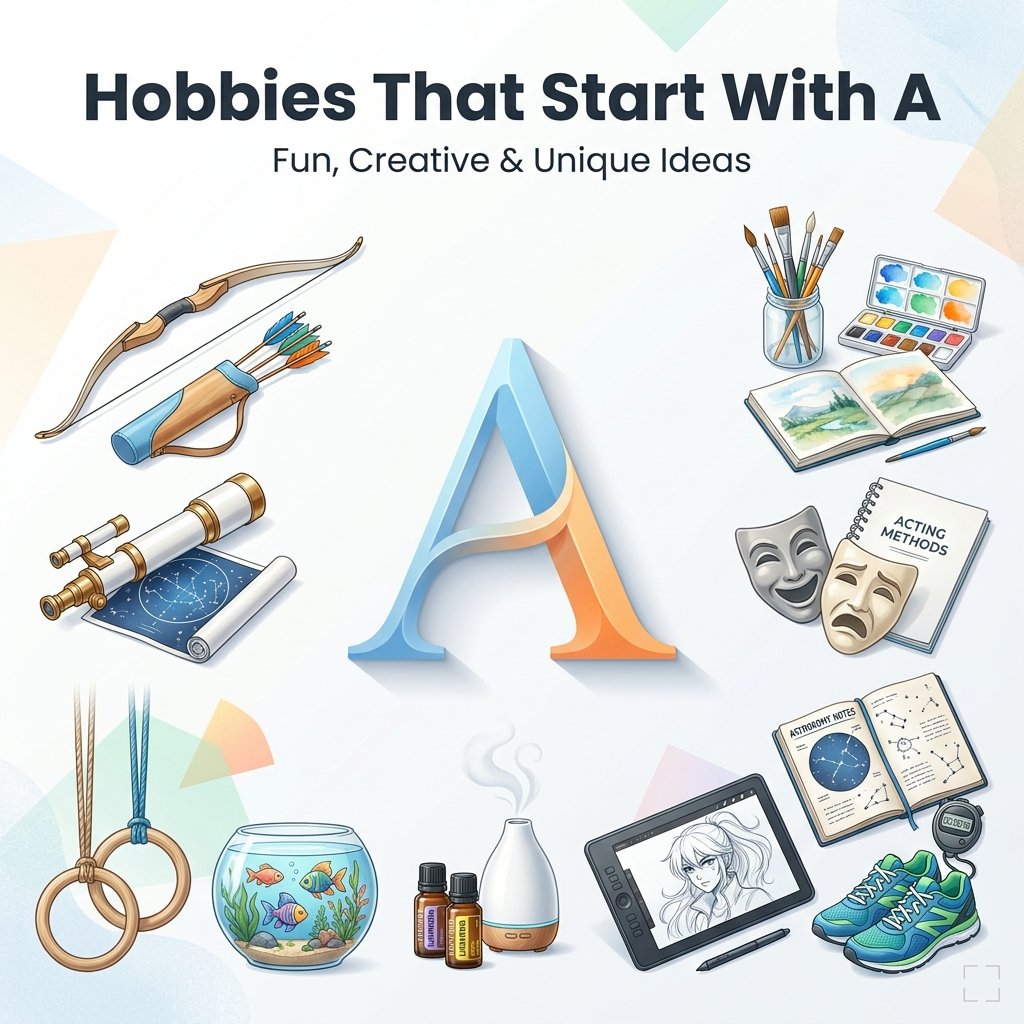
Finding a new hobby can feel overwhelming when you stare at a blank list and have no idea where to begin. If you are working your way through the alphabet or just want a focused starting point, exploring hobbies that start with A is a surprisingly rewarding place to look. The letter A covers everything from shooting arrows at targets to composing ambient soundscapes on a laptop — creative pursuits, outdoor adventures, calming wellness practices, and hands-on science projects all fall within reach.
This guide covers more than 50 genuine hobbies beginning with A, organized by type so you can find what fits your personality, budget, and schedule. Whether you are a complete beginner, a parent searching for a new family activity, a senior looking for a gentle mental pursuit, or simply someone tired of scrolling and ready to make something — there is an A hobby here for you.
What Counts as a Hobby?
A hobby is any activity you do regularly in your free time for enjoyment, relaxation, or personal growth — not because you are paid to do it. Hobbies vary wildly: some are physical, some are creative, some are deeply social, and some are best enjoyed in quiet solitude. Research consistently links regular leisure activities to lower stress levels, improved mood, and sharper cognitive function.
The hobbies in this list all begin with the letter A, and that shared letter happens to span a remarkable range of human interests — from ancient arts like archery and acting to modern digital pursuits like audio editing and Android app development.
Creative and Artistic Hobbies That Start With A
If you feel most alive when making something with your hands — or a brush, a hook, or a stylus — these creative A hobbies are worth exploring.
Acrylic Painting
Acrylic painting is one of the best starting points for anyone who wants to paint but is not sure where to begin. Acrylic paints are water-based, which means easy cleanup with soap and water, and they dry quickly enough to layer and rework without long wait times between sessions. A basic starter kit — a few brushes, a small palette, a set of student-grade acrylics, and a pack of canvas boards — costs around $20 to $40.
The real appeal is flexibility. You can paint loosely and expressively, or you can work tightly and with great detail. Acrylics work on canvas, wood, paper, fabric, and more. Most beginners find the medium forgiving: mistakes dry fast and can be painted over without trace.
Benefits: Stress relief, fine motor development, creative confidence, and a tangible finished product after each session.
Tip: Start with canvas boards rather than stretched canvas. They are cheaper, easier to store, and just as useful for building early skills.
Acrylic Pouring
Acrylic pouring — also called fluid art — is one of the most satisfying beginner-friendly hobbies on this list. You mix acrylic paint with a pouring medium, layer colours into a cup, and tip or swipe the mixture across a canvas to create flowing, organic patterns. No drawing skill is required. The results are unpredictable in the best way.
Starter supplies cost very little: a few bottles of craft paint, a pouring medium, a canvas, and some disposable cups. The process is genuinely meditative — there is something calming about watching colours blend and move on their own.
Benefits: Creative play, relaxation, satisfying results with minimal prior skill.
Abstract Painting
Abstract painting differs from general acrylic painting more in approach than medium. Where realistic painting asks you to represent something accurately, abstract painting asks you to express something — a feeling, an energy, a concept — through colour, shape, and texture. There are no wrong answers, which makes it both freeing and occasionally frustrating for beginners.
If you find yourself paralysed by the blank canvas, a helpful starting point is to pick just two or three colours and focus on texture. Palette knives, sponges, and even crumpled newspaper create interesting marks that representational painters rarely explore.
Benefits: Emotional expression, comfort with experimentation, and creative freedom.
Appliqué
Appliqué is the craft of sewing or bonding decorative fabric shapes onto a textile background. It is used to embellish quilts, cushion covers, clothing, and wall hangings. The technique is centuries old and appears in folk traditions across Europe, Asia, and South America.
For beginners, fusible webbing (a heat-bonding material) makes getting started simple without needing strong sewing skills. Once bonded, shapes can be secured with a simple stitch around the edge. The beauty of appliqué is that it is budget-friendly — fabric scraps work perfectly — and the results look impressive.
Benefits: Creativity, fine motor skills, sustainable use of leftover fabric.
Art Journaling
Art journaling sits at the intersection of visual art and personal writing. The idea is simple: use a blank or mixed-media journal as a space to combine drawing, painting, collage, stamping, and written reflection — with no audience in mind but yourself.
There are no rules. One page might be a painted background with a few handwritten words. Another might be a full collage of torn paper and ink marks. Art journaling has grown considerably as a wellness practice because it gives a non-verbal outlet for processing emotions and thoughts that are difficult to put into conventional words.
Benefits: Self-expression, emotional processing, stress relief, and creative exploration with no performance pressure.
Airbrushing
Airbrushing uses compressed air to push paint through a fine nozzle, producing a spray effect that is difficult to achieve with a conventional brush. It is used in model painting, custom vehicle artwork, murals, cosmetics, cake decorating, and fine art.
Getting started requires an airbrush and a small compressor — a basic beginner set costs around $60 to $100. The learning curve involves mastering air pressure, paint consistency, and movement control, which makes airbrushing intermediate rather than beginner in difficulty. But the results — smooth gradients, fine detail, and dramatic lighting effects — are hard to replicate any other way.
Benefits: Precision, professional finishing quality, cross-application across multiple creative fields.
Amigurumi
Amigurumi is the Japanese art of crocheting small stuffed characters — animals, food items, fictional creatures, and anything else imaginable. The word combines the Japanese words for “knitted” and “stuffed doll.” The finished products are soft, charming, and universally appealing as handmade gifts.
You only need basic crochet skills to start. A beginner who has learned a single crochet stitch can produce their first amigurumi in a weekend. Yarn and a hook cost very little. Dozens of free patterns exist online, and dedicated communities on Reddit and Ravelry share patterns and progress photos.
Benefits: Creativity, fine motor skills, gift-making, and a satisfying sense of completion from relatively short projects.
Animation
Animation is the art of creating the illusion of movement from a sequence of still images. At its simplest, this is a hand-drawn flip book. At its most complex, it is 3D computer animation produced in software like Blender. As a hobby, animation covers a wide middle ground — hand-drawn digital frame sequences, stop-motion with everyday objects, cut-out animation, and 2D digital animation using free tools like Pencil2D.
What makes animation rewarding as a hobby is how many skills it combines: drawing, timing, storytelling, and basic software literacy. Even a ten-second loop takes real craft to produce well.
Benefits: Storytelling skill, digital fluency, creative satisfaction from bringing still images to life.
Outdoor and Adventure Hobbies That Start With A
These hobbies get you outside — whether into a field, onto a mountain, or along a river.
Archery
Archery is one of the most consistently popular hobbies on this list, and it deserves that status. Drawing a bow and releasing an arrow at a target is one of those activities that demands your complete attention — you cannot be thinking about anything else, which makes it a powerful form of active mindfulness.
The entry point is accessible. A beginner recurve bow suitable for target practice costs around $50 to $150, and many clubs provide loaner equipment for new members before you commit to buying. USA Archery maintains a club finder tool that helps beginners locate certified ranges and instructors nearby.
Archery is suitable for ages eight and up, works equally well indoors and outdoors, and accommodates a wide range of physical abilities. Competitive pathways exist for those who want them, but plenty of archers simply enjoy the meditative rhythm of the sport at a local range.
Benefits: Focus, patience, upper-body strength, and the kind of deep concentration that leaves you feeling genuinely rested.
Astronomy
Astronomy as a hobby is the practice of observing the night sky — tracking planets, learning constellations, watching meteor showers, and gradually building an understanding of the universe overhead. It is beginner-friendly in a way that surprises many people: you do not need a telescope to start.
A printed star chart or a free app like Stellarium or SkySafari (both available on Android and iOS) gives you a guided introduction to the night sky without spending a penny. If you want to see Saturn’s rings or the craters of the moon up close, a basic entry-level refractor telescope costing around $100 to $200 opens that up clearly.
NASA’s Astronomy Picture of the Day is a wonderful daily companion for any amateur astronomer — each day features a different image from space, with an explanation written by a professional astronomer.
Astronomy is also a rare hobby that works well as a family activity. Pointing out the moon, finding a planet, and explaining why stars twinkle draws in children and adults alike.
Benefits: Scientific curiosity, patience, sense of wonder, and a natural excuse to spend quiet evenings outdoors.
Abseiling (Rappelling)
Abseiling — known as rappelling in North America — is the controlled descent of a steep rock face or structure using a rope and harness. It developed from mountain rescue techniques and became a popular adventure sport in its own right.
This is not a starter-from-your-garage hobby. The first time you abseil, do it through a certified outdoor guiding company or climbing club that provides instruction, equipment, and a trained supervisor. Once you understand the fundamentals of rope systems and anchor points, the sport becomes progressively more independent.
Benefits: Physical confidence, overcoming fear of heights, genuine adventure, and a strong sense of accomplishment after each descent.
Alpine Skiing
Alpine skiing — downhill skiing on groomed mountain slopes — is a seasonal hobby that rewards anyone willing to invest early effort in lessons. The first two or three days on skis are humbling; the third or fourth feel almost magical as the movement starts to click. Most resorts offer reasonably priced beginner packages that include a lesson, rental equipment, and a beginner-area lift pass.
For those who live far from mountains, even one or two ski trips per year can sustain the hobby as a meaningful seasonal pursuit.
Benefits: Cardiovascular fitness, coordination, outdoor enjoyment, and the exhilaration of moving through a mountain landscape at speed.
Agate Hunting
Agate hunting is the practice of searching riverbeds, lake shores, and beaches for agates — colourful, semi-precious stones formed in volcanic rock. When held up to light, a good agate reveals translucent banding and a warm glow that is hard to find anywhere else in nature.
The cost to start is nearly zero. A rock hammer for splitting promising specimens, a good field guide to local geology, and a pair of comfortable boots are all you need. The activity is meditative — it slows you down, focuses your eyes, and gives a satisfying goal to every outdoor walk.
Benefits: Geology knowledge, outdoor exploration, patience, and a tangible collection that grows over time.
Animal Tracking
Animal tracking involves reading the landscape for signs of wildlife — footprints, scat, fur on branches, gnaw marks on bark, and disturbed earth. It is a skill that reconnects people with the natural environment in a genuinely attentive way.
A field guide to local animal tracks is the only starting investment. Apps like iNaturalist allow you to photograph and identify tracks with help from a global community of naturalists. Once you develop the habit of looking for signs, a walk through any woodland, park, or even a snowy backyard becomes a wildlife documentary.
Benefits: Observation skills, ecological literacy, patience, and a deeper sense of connection to the natural world.
Amateur Mycology
Amateur mycology — the study and responsible foraging of wild fungi — is a hobby that combines forest walks with scientific curiosity and, for the adventurous, a connection to the kitchen. Fungi are among the most biologically complex and visually diverse organisms on earth, and learning to identify them is a surprisingly deep pursuit.
Important safety note: Never consume any wild mushroom you cannot identify with absolute certainty. Cross-reference multiple field guides and, ideally, consult an experienced forager or local mycological society before eating anything foraged. Some toxic species closely resemble edible ones.
The Cornell Lab of Ornithology supports citizen science broadly, and local mycological societies often run guided forays for beginners — these are the safest and most educational way to start.
Benefits: Nature literacy, scientific curiosity, outdoor activity, and the possibility of truly excellent meals.
Arrowhead Hunting
Arrowhead hunting — searching for prehistoric stone tools left by earlier inhabitants of the land — is one of the most personally absorbing collecting hobbies on this list. Finding a hand-knapped flint point in a riverbed or ploughed field is a direct connection to human history that no museum can fully replicate.
Ethics note: In many countries, collecting artefacts from protected archaeological sites, public land, or without landowner permission is illegal. Always research the specific regulations in your area before you begin, and approach the hobby with respect for the cultural heritage involved.
The Smithsonian National Museum of Natural History offers excellent educational resources on stone tool identification and prehistory that can help you develop a knowledgeable eye.
Benefits: History interest, outdoor exploration, observational patience, and a deeply personal collection.
Wellness and Mindfulness Hobbies That Start With A
These hobbies are not about productivity or output — they are about slowing down, reducing stress, and building a better relationship with your own body and mind.
Ashtanga Yoga
Ashtanga yoga is a structured, breath-linked yoga series that moves through a fixed sequence of postures in a set order. Unlike flow yoga classes where the instructor varies the sequence, Ashtanga follows the same primary series each time — which means progress is measurable and practice deepens naturally with repetition.
It is more physically demanding than casual yoga, which surprises some beginners. A strong primary series practice builds genuine strength and flexibility over months of consistent effort. Beginner classes at yoga studios are widely available, and YouTube offers high-quality guided practices for home beginners.
Benefits: Flexibility, core strength, discipline, stress reduction, and a meditative mental state produced by the synchronisation of breath and movement.
Aromatherapy
Aromatherapy is the practice of using plant-derived essential oils — through diffusion, topical application, or inhalation — for relaxation and wellbeing. As a hobby, it has a creative dimension: blending oils into custom combinations for different moods and purposes is a small, personal art form.
Starting costs are low. A basic diffuser costs around $20 to $30, and starter sets of essential oils (lavender, peppermint, eucalyptus, tea tree) are widely available for under $30. From there, the hobby can expand into making room sprays, pillow mists, and simple natural skincare blends.
Benefits: Relaxation, creative blending, a pleasant home environment, and a gentle entry into natural wellness practices.
Adult Coloring
Adult colouring books — filled with intricate geometric patterns, botanical illustrations, and detailed scenes — became a mainstream phenomenon in the mid-2010s and have remained popular as a genuinely effective mindfulness tool. The activity engages the mind just enough to quiet anxious thoughts without demanding creative decisions.
All you need is a colouring book designed for adults and a set of coloured pencils or fine-liner markers. The investment is minimal. Sessions can be as short as fifteen minutes or extend into hours.
Benefits: Stress relief, focused attention, creative satisfaction, and a rare excuse to sit quietly and do something gentle.
Aikido
Aikido is a Japanese martial art based on the principle of redirecting an attacker’s force rather than meeting it with force of your own. It emphasises circular movement, joint control, and balance rather than strength — which makes it accessible across a wider age range than many combat sports.
Classes are available in most cities, and a beginner’s uniform (gi) costs around $40 to $80. The social environment of most aikido dojos is welcoming and non-competitive, which distinguishes it from more tournament-focused martial arts.
Benefits: Balance, coordination, discipline, self-awareness, and a practical foundation in personal safety.
Science and Educational Hobbies That Start With A
These hobbies satisfy intellectual curiosity and build genuine knowledge alongside the pleasure of the activity itself.
Astrophotography
Astrophotography is the practice of photographing celestial objects — the moon, planets, star clusters, nebulae, and galaxies. At its most advanced, it involves a tracking mount, a dedicated astronomy camera, and considerable post-processing skill. But the entry point is much lower than most people assume.
A modern smartphone pointed through a basic telescope eyepiece can photograph the moon in impressive detail. From there, a DSLR or mirrorless camera on a simple tracking mount opens up the Milky Way, star trails, and eventually deep-sky objects like the Andromeda Galaxy — visible as a faint smudge to the naked eye but a detailed spiral in a long-exposure photograph.
Benefits: Technical skill development, stunning visual output, and a deepened understanding of astronomy alongside the photography craft.
Tip for beginners: Start with the moon. It is the easiest celestial target to locate, it fits easily in a camera frame, and a single well-exposed lunar photograph will motivate you to go further.
Aquaponics
Aquaponics is a closed-loop food production system that combines fish farming (aquaculture) with soil-free plant growing (hydroponics). The fish produce waste that feeds the plants; the plants clean the water that returns to the fish tank. The system is almost entirely self-sustaining once established.
As a hobby, aquaponics is part biology experiment, part engineering project, part kitchen garden. Beginner starter kits — a small tank, grow bed, pump, and a handful of plants — are widely available and start at around $100. From there, the system can grow as large as your space allows.
Benefits: Sustainable food production at home, biology education, engineering problem-solving, and genuinely fresh fish and vegetables.
Ancestry Research (Genealogy)
Ancestry research — tracing your family history through historical records, archives, oral history, and DNA testing — is one of the most personally meaningful hobbies on this list. Almost everyone who starts is surprised by what they find.
Free resources make this hobby genuinely accessible without a paid subscription. FamilySearch is a free genealogy database maintained by the Church of Jesus Christ of Latter-day Saints and contains billions of historical records from around the world. Paid platforms like Ancestry.com and MyHeritage offer additional records and DNA matching.
The research skills you develop — reading old handwriting, understanding historical geography, cross-referencing dates across documents — have a real investigative quality that keeps the hobby endlessly engaging.
Benefits: Personal history, research skills, family connection, and a sense of rootedness that is difficult to find elsewhere.
Ant Keeping
Ant keeping is the hobby of maintaining a live ant colony in an artificial habitat (formicarium) and observing the colony’s behaviour over time. It sounds unusual until you sit in front of a thriving colony for the first time — watching a group of insects organise tasks, care for larvae, manage their food stores, and solve spatial problems with no central instruction is genuinely fascinating.
Setup costs are low: a starter formicarium, a founding queen (purchased from a reputable seller), substrate, and basic food. Many keepers start by catching a founding queen during a nuptial flight in late spring or summer — this is free and gives a uniquely personal attachment to the colony from its first moments.
Benefits: Observational patience, biology education, low-cost pet-keeping, and a hobby that rewards sustained attention over months and years.
Aquarium Keeping
Aquarium keeping — maintaining a healthy ecosystem of fish, plants, and water chemistry in a glass tank — is one of the most relaxing and educational hobbies available. Watching fish move through a well-planted tank has a demonstrably calming effect; hospitals and dentists’ waiting rooms have used fish tanks for this reason for decades.
A beginner freshwater setup — a 10- to 20-gallon tank, filter, heater, basic test kit, and a few hardy fish like danios or platies — costs around $50 to $100. The learning curve involves understanding the nitrogen cycle (the biological process that makes a tank safe for fish), which most beginners master within the first month.
Benefits: Responsibility, patience, biology knowledge, and a living, beautiful focal point in any room.
Aquascaping
Aquascaping is the art of designing a planted aquarium as a visual landscape — arranging rocks, driftwood, and aquatic plants to create compositions that resemble mountains, forests, or natural riverscapes. It is a natural next step for anyone who has enjoyed aquarium keeping and wants to bring an aesthetic dimension to the tank.
The Dutch and Nature Style aquascapes created by professionals like Takashi Amano (who largely defined the modern art form) are complex and beautiful. But beginner aquascapes — a few rocks, a handful of easy plants like Java fern or Anubias, and a small school of nano fish — are entirely achievable and deeply satisfying.
Benefits: Creativity, aquatic biology, patience, and an ongoing living artwork that changes and grows over time.
Music Hobbies That Start With A
Learning to play or compose music is one of the most consistently rewarding long-term hobbies available. These A options cover very different instruments and styles.
Acoustic Guitar
The acoustic guitar is probably the most widely learned instrument in the world, and for good reason. It is portable, versatile enough to play almost any style of music, and genuinely self-contained — unlike an electric guitar, you do not need an amplifier. A decent beginner guitar costs around $100 to $150.
Free learning resources have never been better. JustinGuitar, the free online platform, has helped millions of beginners reach a functional playing level at no cost. YouTube channels by experienced teachers cover every style from folk to fingerpicking to blues. Most beginners can play simple songs within their first few weeks.
Benefits: Musical expression, coordination, stress relief, and a skill that lasts a lifetime with relatively modest early investment.
Accordion
The accordion is a portable free-reed instrument driven by bellows pressure. It is central to a remarkable range of musical traditions — French musette, Argentine tango, German folk music, Cajun zydeco, klezmer, and more. Playing one well requires coordination between both hands and the bellows, which places it at an intermediate difficulty level.
That said, basic chord accompaniment on a diatonic button accordion (often used in folk traditions) is accessible to determined beginners. Lessons from an experienced teacher will shorten the learning curve considerably.
Benefits: Musical versatility, cultural connection, coordination, and a genuinely distinctive voice as an instrument.
Autoharp
The autoharp is a chorded zither that produces chords at the press of a button while the other hand strums the strings. It is one of the most accessible string instruments available — a beginner can produce recognisable music on their first day, which is rare for any stringed instrument. It is central to American folk and Appalachian music traditions.
A quality entry-level autoharp costs around $150 to $250. Unlike guitar or piano, it requires no knowledge of music theory to start: press a chord button labelled “G,” strum, and you are playing in G.
Benefits: Immediate musical results, rhythm skill development, and a connection to rich folk music traditions.
Ambient Music Composition
Ambient music — atmospheric, texture-driven, often wordless — is a genre ideally suited to hobbyist composers because it rewards patience and listening over technical virtuosity. The genre’s pioneers, including Brian Eno and Harold Budd, built work from layered tones and slowly evolving sounds rather than conventional melody and rhythm.
Creating ambient music at home is entirely achievable with free software. GarageBand (free on Mac and iOS) and Audacity (free on all platforms) both allow beginners to record, layer, and process sounds. A synthesiser keyboard adds more options but is not required to start.
Benefits: Creativity, sound design literacy, deep listening skill, and a meditative creative process that can itself feel like a form of relaxation.
Technology and Digital Hobbies That Start With A
These hobbies live at the intersection of creativity and technical skill — and most can be started with a computer you already own.
Amateur Radio (Ham Radio)
Amateur radio — informally called ham radio — is the hobby of using licensed radio frequencies to communicate locally, nationally, and internationally. Operators build antennas, experiment with propagation, participate in contests, and form emergency communication networks that activate during disasters when conventional infrastructure fails.
In the United States, a Technician licence (the entry-level licence) requires passing a 35-question multiple-choice exam with no prerequisite. The American Radio Relay League (ARRL) provides study materials, practice exams, and a club finder for new operators. Equipment costs for a simple handheld radio begin around $30.
Benefits: Technical skill, global community, emergency preparedness, and the satisfaction of communicating using technology you understand completely.
Audio Editing
Audio editing — recording and shaping sound using a computer — has grown enormously as a hobby alongside the podcasting and independent music boom. Free tools like Audacity and the iOS/Mac version of GarageBand give beginners access to professional-quality recording and editing capabilities at zero cost.
As a hobby, audio editing can take many directions: producing a personal podcast, creating soundscapes for video content, mixing original music, or simply processing and archiving field recordings from nature walks. The learning curve is gradual and largely self-directed.
If this appeals to you alongside an interest in AI tools that start with A, there are now several AI-assisted audio tools that make noise removal, transcription, and mixing much faster for beginners.
Benefits: Storytelling, technical audio skill, creative content production, and a highly transferable digital skillset.
Android App Development
Building Android apps as a hobby means learning to write code that runs on real devices — and potentially sharing your creations with a global audience through the Google Play Store. The main programming language is Kotlin (preferred by Google) or Java, both taught extensively through free resources.
Android Studio, the official development environment, is free to download. Google’s own developer documentation is exceptionally well-written for beginners. Many developers start with a simple calculator, a to-do list, or a basic quiz app — projects small enough to finish but complex enough to teach the fundamentals.
Benefits: Programming fluency, problem-solving, portfolio building, and the practical satisfaction of creating software that runs on real devices.
Aeromodelling (RC Aircraft)
Aeromodelling is the hobby of building and flying remote-controlled aircraft — from simple foam-wing trainers and electric gliders to sophisticated scale replicas of historic planes. The hobby has two distinct appeals: the building process (which involves engineering, problem-solving, and craftsmanship) and the flying process (which demands precise hand-eye coordination and spatial awareness).
Beginner entry points include ready-to-fly (RTF) foam trainers, which cost around $80 to $150 and can be in the air within an hour of purchase. Local model aircraft clubs often allow beginners to fly under supervision before committing to equipment purchases.
Benefits: Engineering skill, aerodynamics knowledge, hand-eye coordination, and a strong community of fellow enthusiasts.
Collecting Hobbies That Start With A
Collecting hobbies reward patience, research, and the joy of the hunt. These A options range from free to start to as expensive as you choose.
Antiquing
Antiquing is the practice of searching for antiques — older objects valued for their age, craftsmanship, or history — at flea markets, estate sales, charity shops, and dedicated antique dealers. The activity is part treasure hunt, part history lesson, and part social experience.
The cost to start is essentially zero: you can spend an entire Saturday at a flea market without buying anything and come away richer for the knowledge of what you saw and handled. The research dimension — learning what makes a piece valuable, understanding periods and styles, identifying maker’s marks — is genuinely absorbing.
Benefits: Historical knowledge, bargaining skill, a trained eye for quality and craftsmanship, and the occasional extraordinary find.
Antiquarian Book Collecting
Antiquarian book collecting focuses specifically on rare, old, or historically significant books — first editions, limited printings, illustrated classics, and volumes with notable provenance. It is a deeply intellectual hobby that sits at the intersection of literature, history, bibliography, and material culture.
Finding and evaluating books requires research skills, patience, and a developing eye for condition, edition, and authenticity. Many serious collectors specialise narrowly — a single author, a historical period, a subject — which makes the pursuit more focused and manageable.
Benefits: Historical knowledge, archival care, aesthetic pleasure, and a collection that tends to hold value over time.
Art Collecting
Art collecting does not require a large budget to be meaningful. Local artists sell original works at open studios, community markets, and online platforms like Etsy and Saatchi Art. Starting a collection with small, affordable originals from emerging artists is genuinely satisfying and far more personal than buying prints.
The educational dimension — learning to look at art, understanding movements and periods, developing your own taste — deepens continuously. Many collectors find that the research involved in making a purchase is as enjoyable as the purchase itself.
Benefits: Aesthetic appreciation, cultural knowledge, a home enriched by original art, and a collection that can grow steadily over years.
Gardening and Nature-Based Hobbies That Start With A
Apiculture (Beekeeping)
Apiculture — the practice of keeping honey bees — is one of the most ecologically meaningful hobbies available. A healthy beehive actively benefits the surrounding environment through pollination, and the honey produced is a direct, personal product of that relationship between the keeper, the bees, and the local landscape.
Getting started requires proper equipment: a hive box, protective suit, smoker, and hive tool. The American Beekeeping Federation offers beginner resources, local association finders, and guidance on regulations. Most new beekeepers start with a single hive and expand gradually as their confidence and knowledge grow.
Benefits: Ecosystem contribution, biology knowledge, fresh honey, and a deeply observational relationship with one of nature’s most complex social insects.
Aquaponics
(See the Science and Educational section above for a full description — aquaponics appears here as a gardening hobby because its primary output is food production: fresh fish and vegetables grown together in a single self-sustaining system.)
Apple Grafting
Apple grafting is the horticultural technique of joining a scion (a short cutting from a desired apple variety) to a rootstock (a young tree whose root system will support the new growth). The result is a tree that produces the fruit of the scion variety on the roots of the rootstock — allowing gardeners to grow rare or heirloom apple varieties that are unavailable in commercial nurseries.
The technique is intermediate in difficulty and requires a sharp grafting knife, proper tape, and good timing (late winter to early spring is typically best). Results take patience — a grafted tree may take two or three years to produce fruit. But for gardeners who enjoy both precision craft and long-term projects, it is extremely rewarding.
Benefits: Horticultural skill, control over fruit variety, and the long-term satisfaction of growing something genuinely rare.
Social and Group Hobbies That Start With A
Some hobbies are best enjoyed with other people. These A options have a strong community and social dimension.
Acting and Improv
Community theatre, amateur dramatics, and improv comedy groups offer a genuinely accessible entry into performing arts. Most community groups welcome complete beginners, and the atmosphere tends to be warm and supportive rather than competitive.
Improv theatre in particular — where scenes and characters are created spontaneously, without a script — builds skills in listening, quick thinking, and collaborative creativity that are useful well beyond the stage. Many workplaces have begun using improv workshops for team-building for exactly this reason.
Acting and performing arts can sometimes grow into creative careers for those who discover a genuine passion — but the hobby itself needs no professional ambition to be deeply worthwhile.
Benefits: Communication, confidence, empathy, creative collaboration, and a strong social community.
Airsoft
Airsoft is a team sport in which players use replica firearms to fire small plastic BBs at opponents during structured scenarios — recreating military or law enforcement situations in a safe, sporting context. It requires appropriate protective gear (a full-seal eye mask is non-negotiable) and is played at dedicated outdoor sites or indoor arenas.
The equipment investment is moderate — a beginner airsoft gun and safety gear costs around $60 to $150. Many sites offer rental equipment for first-timers so you can experience the hobby before committing to a purchase.
Benefits: Strategy, teamwork, physical activity, and a strong camaraderie among regular players.
Archery Tag
Archery tag is a team game that combines elements of dodgeball with archery, using foam-tipped arrows and compound bows designed for safety at close range. No prior archery skill is needed, and indoor venues providing all equipment are now available in most medium-sized cities.
It is an ideal group activity for social occasions — birthday parties, team outings, or casual friend groups — that want something more active and memorable than a restaurant booking.
Benefits: Teamwork, agility, strategy, and genuine fun without a steep skill barrier.
Axe Throwing
Recreational axe throwing has grown from a niche Canadian pastime into a global leisure industry. Indoor venues — often styled as rustic taverns — provide safety-rated axes, wooden targets, and basic instruction. Most beginners are landing consistent throws within twenty minutes.
No equipment purchase is necessary for casual axe throwing — venues supply everything. The sport is inherently social, works well for competitive personalities, and satisfies a primitive desire to hit something satisfying with something heavy.
Benefits: Coordination, stress relief, friendly competition, and a memorable shared experience.
Budget-Friendly Hobbies That Start With A (Under $20 to Begin)
Not every hobby requires significant investment. These options from this list can be started for under $20:
- Adult coloring — a book and basic pencils cost under $15
- Art journaling — any blank notebook and whatever pens you own work fine to start
- Ancestry research — FamilySearch and many archive databases are entirely free
- Astronomy — a star chart app (Stellarium) is free; a printed chart costs under $5
- Animal tracking — free to start; a field guide costs around $15 to $20
- Abstract painting — a few tubes of craft paint and a canvas board start under $15
- Adult coloring — coloring supplies are among the cheapest creative hobby entry points available
Budget should never be a barrier to exploring a new hobby. Most of the options on this list have a free or very low-cost entry point, with room to invest more as your commitment grows.
Hobbies That Start With A for Kids and Families
Several hobbies on this list are particularly well-suited to children and family participation:
- Archery — junior programs exist at most clubs from age eight upward; supervised range sessions are safe and structured
- Astronomy — family stargazing requires no equipment and makes for memorable evenings outdoors
- Acrylic painting — student-grade children’s paint sets make this suitable from age five upward
- Aquarium keeping — a small starter fish tank teaches children responsibility, patience, and basic biology
- Acting and drama — most areas have youth drama groups; improv games work for children from about age seven
- Amigurumi — children who can handle a crochet hook (typically from age eight or nine) enjoy the immediate, cute results
- Animal tracking — nature walks focused on wildlife signs work for any age and cost nothing
The best family hobbies share a quality: the activity itself is engaging enough that the “educational” dimension does not need to be announced. Children who track a fox’s footprints across a snowy field are learning ecology, observation, and patience without noticing.
Hobbies That Start With A for Seniors
Hobbies offer particular benefits for older adults — maintaining cognitive engagement, providing social connection, and giving daily life a sense of purposeful activity. These A hobbies are well-suited to seniors:
- Adult coloring — gentle, absorbing, and genuinely effective for mindfulness
- Ancestry research — cognitively stimulating, deeply personal, and can be done entirely from home
- Aquarium keeping — calming and manageable; a small tank requires only light daily care
- Autoharp — one of the most accessible instruments for beginners at any age
- Astronomy — suitable for any physical ability level; requires only clear evenings and a comfortable chair
- Aromatherapy — gentle, creative, and low-cost
- Art journaling — no performance pressure and richly self-expressive
- Antiquing — social, intellectually engaging, and naturally paced
The hobbies above share a low physical demand while remaining mentally stimulating — a combination particularly well-suited to maintaining cognitive vitality over time.
How to Choose the Right Hobby From This List
With more than fifty options, narrowing down can feel as difficult as finding a hobby in the first place. These questions help.
Think About What You Want to Get Out of a Hobby
Be honest with yourself about what you are actually looking for:
- Relaxation? Lean toward adult colouring, art journaling, aromatherapy, or ambient music composition.
- Physical activity? Look at archery, aikido, alpine skiing, abseiling, or amateur boxing.
- Social connection? Acting, axe throwing, airsoft, archery tag, or an astronomy club all offer strong communities.
- Learning and intellectual engagement? Ancestry research, amateur mycology, astrophotography, aquaponics, or amateur radio.
- Creative expression? Acrylic painting, amigurumi, abstract painting, animation, or art journaling.
Start With What You Already Enjoy
A hobby should extend an existing interest, not replace it. If you love walking in nature, animal tracking and agate hunting add a purposeful layer to something you already do. If you enjoy fixing things, auto restoration or aeromodelling will feel natural. If you already listen to music attentively, learning the acoustic guitar or accordion uses that existing sensitivity.
Set a Starter Budget
Most hobbies on this list cost under $50 to try genuinely. Start at the low end. Borrow equipment where possible, use club or venue gear before buying your own, and avoid purchasing specialist items until you are sure the hobby appeals to you after a few real sessions.
Give It at Least 30 Days
The first session of any hobby is almost never representative of what the hobby actually feels like. Most activities have an awkward beginning phase — the first few weeks of guitar, the first few aquarium water chemistry failures, the first few arrows that miss the target entirely. Most experienced hobbyists will tell you that pushing through the first month almost always leads somewhere worth going.
Frequently Asked Questions About Hobbies That Start With A
What are some hobbies that start with the letter A?
There are more than 50 hobbies beginning with A, including archery, astronomy, acrylic painting, aquarium keeping, ancestry research, aikido, amateur radio, animation, aquaponics, and axe throwing. They span creative, outdoor, wellness, educational, and social categories.
What is a good hobby for beginners that starts with A?
Excellent beginner options include acrylic pouring (no prior art skill needed), adult colouring (minimal cost and immediate results), acoustic guitar (free online lessons widely available), astronomy (starts with just an app), and ancestry research (free resources exist for all skill levels).
What hobbies that start with A can I do at home?
Many A hobbies work entirely at home: acrylic painting, art journaling, amigurumi, ambient music composition, audio editing, Android app development, aquarium keeping, aquaponics, ancestry research, adult colouring, and aromatherapy all require no travel.
Are there any cheap hobbies starting with A?
Yes — many A hobbies cost under $20 to start. Adult colouring, art journaling, ancestry research, astronomy (using a free app), and animal tracking are all effectively free or very low cost. Abstract painting and abstract pouring need only basic craft supplies.
What are creative hobbies that start with A?
Creative A hobbies include acrylic painting, abstract painting, acrylic pouring, appliqué, art journaling, amigurumi, airbrushing, animation, ambient music composition, and aquascaping (which combines biology with aesthetic design).
What outdoor activities start with the letter A?
Outdoor A hobbies include archery, astronomy, abseiling, alpine skiing, agate hunting, animal tracking, amateur mycology, arrowhead hunting, and apiculture (beekeeping). Most can be started through local clubs or guided experiences.
What are relaxing hobbies that start with A?
The most relaxing A hobbies are adult colouring, art journaling, aromatherapy, aquarium keeping, ambient music composition, and astronomy (particularly quiet evening stargazing). Ancestry research is also deeply absorbing in a calm, focused way.
Are there any hobbies that start with A for kids?
Archery (from age eight), astronomy, acrylic painting, aquarium keeping, acting and improv, and amigurumi all work well for children. Animal tracking is an excellent free family activity that suits all ages.
What hobbies starting with A are good for seniors?
Adult colouring, ancestry research, aquarium keeping, autoharp, astronomy, aromatherapy, art journaling, and antiquing are all particularly well-suited to older adults — they are low-impact, cognitively engaging, and easy to pace to personal energy levels.
What A hobbies are good for mental health?
Research links leisure activities broadly to reduced stress and improved mood. A hobbies often cited for mindfulness and mental wellness benefits include adult colouring, art journaling, aromatherapy, ashtanga yoga, acoustic guitar, and aquarium watching.
Is archery a good hobby for beginners?
Yes — archery is one of the most beginner-friendly outdoor sports. Most ranges offer introductory sessions with loaner equipment. USA Archery maintains a club directory to help newcomers find certified instruction and practice facilities near them.
What equipment do I need to start astronomy as a hobby?
To begin, nothing — a free app like Stellarium on any smartphone provides a guided introduction to the night sky. When you are ready to go further, a basic refractor telescope in the $100 to $200 range shows Saturn’s rings and Jupiter’s moons clearly.
Can ancestry research be a hobby?
Absolutely. Tracing your family history is an absorbing, ongoing, and deeply personal pursuit. FamilySearch offers billions of historical records for free, making it possible to start without any subscription cost.
What is aquascaping and is it hard to start?
Aquascaping is the art of designing planted aquariums as living landscapes — arranging rocks, wood, and plants into aesthetically composed underwater scenes. Beginner aquascapes using easy plants like Java fern and Anubias in a small tank are achievable and rewarding within the first few weeks.
What are some unique or unusual hobbies that start with A?
Less commonly known A hobbies include ant keeping (observing live ant colonies in a glass formicarium), aquatint printmaking, aeromodelling, ambient music composition, apple grafting, aquaponics, and amateur mycology — each one genuinely distinctive and deeply involving for those who discover them.
Full Quick-Reference List of Hobbies That Start With A
| Hobby | Category | Difficulty | Approx. Starter Cost |
|---|---|---|---|
| Abseiling | Outdoor / Adventure | Advanced | $0 (guided) |
| Abstract Painting | Creative | Beginner | Under $20 |
| Accordion | Music | Intermediate | $100–$300 |
| Acoustic Guitar | Music | Beginner | $100–$150 |
| Acrylic Painting | Creative | Beginner | $20–$40 |
| Acrylic Pouring | Creative | Beginner | Under $20 |
| Aeromodelling | Technology / Craft | Intermediate | $80–$150 |
| Agate Hunting | Outdoor / Collecting | Intermediate | Under $20 |
| Airbrushing | Creative | Intermediate | $60–$100 |
| Aikido | Wellness / Fitness | Intermediate | $40–$80 (uniform) |
| Airsoft | Social / Sport | Beginner | $60–$150 |
| Alpine Skiing | Outdoor / Sport | Intermediate | $50–$150 (lessons + rental) |
| Amateur Boxing | Fitness | Intermediate | $50–$100 |
| Amateur Metal Detecting | Outdoor / Collecting | Beginner | $100–$200 |
| Amateur Mycology | Outdoor / Educational | Intermediate | Under $20 |
| Amateur Radio | Technology | Intermediate | $30–$100 |
| Ambient Music | Music / Technology | Intermediate | Free (software) |
| Amigurumi | Creative / Craft | Beginner | Under $20 |
| Android App Development | Technology | Intermediate | Free |
| Animal Photography | Photography | Intermediate | Varies |
| Animal Tracking | Outdoor | Beginner | Under $20 |
| Animation | Creative / Technology | Intermediate | Free (software) |
| Ant Keeping | Educational / Science | Beginner | $30–$60 |
| Antiquarian Book Collecting | Collecting | Intermediate | Varies |
| Antiquing | Collecting | Beginner | $0 to browse |
| Apiculture | Gardening / Nature | Intermediate | $200–$300 (full starter kit) |
| Apple Grafting | Gardening | Intermediate | Under $30 |
| Appliqué | Creative / Craft | Beginner | Under $20 |
| Aquarium Keeping | Educational / Nature | Beginner | $50–$100 |
| Aquaponics | Educational / Gardening | Intermediate | $100–$200 |
| Aquascaping | Educational / Creative | Intermediate | $60–$150 |
| Archery | Outdoor / Sport | Intermediate | $50–$150 |
| Archery Tag | Social / Sport | Beginner | $0 (venue supplies) |
| Aromatherapy | Wellness | Beginner | Under $30 |
| Arrowhead Hunting | Outdoor / Collecting | Intermediate | Under $20 |
| Arrow Making | Craft | Intermediate | $30–$60 |
| Art Collecting | Collecting | Beginner | Varies |
| Art Journaling | Creative / Wellness | Beginner | Under $15 |
| Ashtanga Yoga | Wellness / Fitness | Intermediate | $0–$20 (mat) |
| Astrophotography | Science / Photography | Advanced | $100–$500+ |
| Astronomy | Science / Educational | Beginner | Free–$200 |
| Audio Editing | Technology | Intermediate | Free |
| Autoharp | Music | Beginner | $150–$250 |
| Auto Detailing | Craft / Hobby | Beginner | $30–$60 |
| Auto Restoration | Craft / Hobby | Advanced | Varies widely |
| Axe Throwing | Social / Sport | Beginner | $0 (venue supplies) |
| Acting / Improv | Social / Performing Arts | Beginner | $0–$20 |
| Adult Coloring | Wellness / Creative | Beginner | Under $15 |
| Ancestry Research | Educational / Personal | Beginner | Free |
| Aquatint Printmaking | Creative / Art | Advanced | $100+ |
Final Thoughts
The letter A turns out to be one of the richest starting points in the entire alphabet for discovering a new hobby. From the meditative rhythm of archery to the living science project of aquaponics, from the quiet satisfaction of ancestry research to the social energy of axe throwing — the range of genuine hobbies that start with A is wide enough to include something meaningful for almost anyone.
The most important step is the first one: choose one hobby that genuinely interests you, gather only what you need to start simply, and give it a real try over at least four weeks. Most people who find a lasting hobby will tell you the same thing — they almost quit in the first few sessions.
Start with one. See where it goes.
If you enjoyed exploring this list, you might also find value in browsing AI tools that start with A for digital hobby support, or discovering skills that start with P if you want hobbies that can strengthen your professional profile.
Part 2 — Document Version
SEO Title: 50+ Hobbies That Start With A (For Every Interest) Meta Description: Discover 50+ hobbies that start with A — from archery to astronomy. Find creative, outdoor, relaxing, and unique ideas for all ages and budgets. URL Slug: /hobbies-that-start-with-a/
50+ Hobbies That Start With A (For Every Interest)
Finding a new hobby can feel overwhelming when you stare at a blank list and have no idea where to begin. If you are working your way through the alphabet or just want a focused starting point, exploring hobbies that start with A is a surprisingly rewarding place to look. The letter A covers everything from shooting arrows at targets to composing ambient soundscapes on a laptop — creative pursuits, outdoor adventures, calming wellness practices, and hands-on science projects all fall within reach.
This guide covers more than 50 genuine hobbies beginning with A, organized by type so you can find what fits your personality, budget, and schedule. Whether you are a complete beginner, a parent searching for a new family activity, a senior looking for a gentle mental pursuit, or simply someone tired of scrolling and ready to make something — there is an A hobby here for you.
What Counts as a Hobby?
A hobby is any activity you do regularly in your free time for enjoyment, relaxation, or personal growth — not because you are paid to do it. Hobbies vary wildly: some are physical, some are creative, some are deeply social, and some are best enjoyed in quiet solitude. Research consistently links regular leisure activities to lower stress levels, improved mood, and sharper cognitive function.
The hobbies in this list all begin with the letter A, and that shared letter happens to span a remarkable range of human interests — from ancient arts like archery and acting to modern digital pursuits like audio editing and Android app development.
Creative and Artistic Hobbies That Start With A
If you feel most alive when making something with your hands — or a brush, a hook, or a stylus — these creative A hobbies are worth exploring.
Acrylic Painting
Acrylic painting is one of the best starting points for anyone who wants to paint but is not sure where to begin. Acrylic paints are water-based, which means easy cleanup with soap and water, and they dry quickly enough to layer and rework without long wait times between sessions. A basic starter kit — a few brushes, a small palette, a set of student-grade acrylics, and a pack of canvas boards — costs around $20 to $40.
The real appeal is flexibility. You can paint loosely and expressively, or you can work tightly and with great detail. Acrylics work on canvas, wood, paper, fabric, and more. Most beginners find the medium forgiving: mistakes dry fast and can be painted over without trace.
Benefits: Stress relief, fine motor development, creative confidence, and a tangible finished product after each session.
Tip: Start with canvas boards rather than stretched canvas. They are cheaper, easier to store, and just as useful for building early skills.
Acrylic Pouring
Acrylic pouring — also called fluid art — is one of the most satisfying beginner-friendly hobbies on this list. You mix acrylic paint with a pouring medium, layer colours into a cup, and tip or swipe the mixture across a canvas to create flowing, organic patterns. No drawing skill is required. The results are unpredictable in the best way.
Starter supplies cost very little: a few bottles of craft paint, a pouring medium, a canvas, and some disposable cups. The process is genuinely meditative — there is something calming about watching colours blend and move on their own.
Benefits: Creative play, relaxation, satisfying results with minimal prior skill.
Abstract Painting
Abstract painting differs from general acrylic painting more in approach than medium. Where realistic painting asks you to represent something accurately, abstract painting asks you to express something — a feeling, an energy, a concept — through colour, shape, and texture. There are no wrong answers, which makes it both freeing and occasionally frustrating for beginners.
If you find yourself paralysed by the blank canvas, a helpful starting point is to pick just two or three colours and focus on texture. Palette knives, sponges, and even crumpled newspaper create interesting marks that representational painters rarely explore.
Benefits: Emotional expression, comfort with experimentation, and creative freedom.
Appliqué
Appliqué is the craft of sewing or bonding decorative fabric shapes onto a textile background. It is used to embellish quilts, cushion covers, clothing, and wall hangings. The technique is centuries old and appears in folk traditions across Europe, Asia, and South America.
For beginners, fusible webbing makes getting started simple without needing strong sewing skills. Once bonded, shapes can be secured with a simple stitch around the edge. The beauty of appliqué is that it is budget-friendly — fabric scraps work perfectly — and the results look impressive.
Benefits: Creativity, fine motor skills, sustainable use of leftover fabric.
Art Journaling
Art journaling sits at the intersection of visual art and personal writing. The idea is simple: use a blank or mixed-media journal as a space to combine drawing, painting, collage, stamping, and written reflection — with no audience in mind but yourself.
There are no rules. One page might be a painted background with a few handwritten words. Another might be a full collage of torn paper and ink marks. Art journaling has grown as a wellness practice because it gives a non-verbal outlet for processing emotions and thoughts that are difficult to put into conventional words.
Benefits: Self-expression, emotional processing, stress relief, and creative exploration with no performance pressure.
Airbrushing
Airbrushing uses compressed air to push paint through a fine nozzle, producing a spray effect that is difficult to achieve with a conventional brush. It is used in model painting, custom vehicle artwork, murals, cosmetics, cake decorating, and fine art.
Getting started requires an airbrush and a small compressor — a basic beginner set costs around $60 to $100. The learning curve involves mastering air pressure, paint consistency, and movement control, making it intermediate in difficulty. But the results — smooth gradients, fine detail, and dramatic lighting effects — are hard to replicate any other way.
Benefits: Precision, professional finishing quality, cross-application across multiple creative fields.
Amigurumi
Amigurumi is the Japanese art of crocheting small stuffed characters — animals, food items, fictional creatures, and anything else imaginable. The word combines the Japanese words for “knitted” and “stuffed doll.” The finished products are soft, charming, and universally appealing as handmade gifts.
You only need basic crochet skills to start. A beginner who has learned a single crochet stitch can produce their first amigurumi in a weekend. Yarn and a hook cost very little. Dozens of free patterns exist online.
Benefits: Creativity, fine motor skills, gift-making, and a satisfying sense of completion from relatively short projects.
Animation
Animation is the art of creating the illusion of movement from a sequence of still images. As a hobby, it covers a wide range — hand-drawn digital frame sequences, stop-motion with everyday objects, cut-out animation, and 2D digital animation using free tools like Pencil2D.
What makes animation rewarding is how many skills it combines: drawing, timing, storytelling, and basic software literacy. Even a ten-second loop takes real craft to produce well.
Benefits: Storytelling skill, digital fluency, creative satisfaction from bringing still images to life.
Outdoor and Adventure Hobbies That Start With A
These hobbies get you outside — whether into a field, onto a mountain, or along a river.
Archery
Archery is one of the most consistently popular hobbies on this list, and it deserves that status. Drawing a bow and releasing an arrow at a target is one of those activities that demands your complete attention — you cannot be thinking about anything else, which makes it a powerful form of active mindfulness.
The entry point is accessible. A beginner recurve bow suitable for target practice costs around $50 to $150, and many clubs provide loaner equipment for new members before you commit to buying. USA Archery (usarchery.org) maintains a club finder tool that helps beginners locate certified ranges and instructors nearby.
Archery is suitable for ages eight and up, works equally well indoors and outdoors, and accommodates a wide range of physical abilities.
Benefits: Focus, patience, upper-body strength, and the kind of deep concentration that leaves you feeling genuinely rested.
Astronomy
Astronomy as a hobby is the practice of observing the night sky — tracking planets, learning constellations, watching meteor showers, and gradually building an understanding of the universe overhead. A free app like Stellarium or SkySafari gives you a guided introduction at zero cost. A basic entry-level refractor telescope costing around $100 to $200 opens up Saturn’s rings and Jupiter’s moons clearly.
NASA’s Astronomy Picture of the Day (apod.nasa.gov) is a wonderful daily companion for any amateur astronomer.
Benefits: Scientific curiosity, patience, sense of wonder, and a natural excuse to spend quiet evenings outdoors.
Abseiling (Rappelling)
Abseiling is the controlled descent of a steep rock face or structure using a rope and harness. The first time you abseil, do it through a certified outdoor guiding company or climbing club that provides instruction, equipment, and a trained supervisor.
Benefits: Physical confidence, overcoming fear of heights, genuine adventure, and a strong sense of accomplishment.
Alpine Skiing
Alpine skiing is a seasonal downhill snow sport that rewards anyone willing to invest in early lessons. Most resorts offer beginner packages including a lesson, rental equipment, and a beginner-area lift pass.
Benefits: Cardiovascular fitness, coordination, outdoor enjoyment, and the exhilaration of moving through a mountain landscape at speed.
Agate Hunting
Agate hunting is the practice of searching riverbeds, lake shores, and beaches for agates — colourful, semi-precious stones formed in volcanic rock. A rock hammer, field guide, and comfortable boots are all you need. The activity is meditative and gives a satisfying goal to every outdoor walk.
Benefits: Geology knowledge, outdoor exploration, patience, and a tangible collection that grows over time.
Animal Tracking
Animal tracking involves reading the landscape for signs of wildlife — footprints, scat, fur on branches, gnaw marks, and disturbed earth. A field guide to local animal tracks is the only starting investment.
Benefits: Observation skills, ecological literacy, patience, and a deeper connection to the natural world.
Amateur Mycology
Amateur mycology is the study and responsible foraging of wild fungi. It combines forest walks with scientific curiosity and, for the adventurous, a connection to the kitchen.
Important safety note: Never consume any wild mushroom you cannot identify with absolute certainty. Consult experienced foragers or a local mycological society before eating anything foraged.
Benefits: Nature literacy, scientific curiosity, outdoor activity, and the possibility of excellent meals.
Arrowhead Hunting
Arrowhead hunting — searching for prehistoric stone tools in fields and riverbeds — is one of the most personally absorbing collecting hobbies available. Finding a hand-knapped flint point is a direct connection to human history.
Ethics note: Research regulations in your area before collecting. Many regions have laws protecting archaeological artefacts. The Smithsonian National Museum of Natural History (naturalhistory.si.edu) offers excellent resources on stone tool identification and prehistory.
Benefits: History interest, outdoor exploration, observational patience, and a deeply personal collection.
Wellness and Mindfulness Hobbies That Start With A
These hobbies are about slowing down, reducing stress, and building a better relationship with your own body and mind.
Ashtanga Yoga
Ashtanga yoga is a structured, breath-linked yoga series that moves through a fixed sequence of postures in a set order. More physically demanding than casual yoga, it builds genuine strength and flexibility over months of consistent practice. Beginner classes at studios and free YouTube practices both work well.
Benefits: Flexibility, core strength, discipline, stress reduction, and a meditative mental state from breath-movement synchronisation.
Aromatherapy
Aromatherapy is the practice of using plant-derived essential oils for relaxation and wellbeing. Starting costs are low — a basic diffuser costs around $20 to $30 and starter oil sets are widely available for under $30. The creative dimension of blending custom combinations for different moods is a personal art form in itself.
Benefits: Relaxation, creative blending, a pleasant home environment, and a gentle entry into natural wellness practices.
Adult Coloring
Adult colouring books — filled with intricate geometric patterns and botanical illustrations — engage the mind just enough to quiet anxious thoughts without demanding creative decisions. All you need is a book designed for adults and a set of coloured pencils or fine-liner markers.
Benefits: Stress relief, focused attention, creative satisfaction, and a rare excuse to sit quietly and do something gentle.
Aikido
Aikido is a Japanese martial art based on redirecting an attacker’s force rather than meeting it with force. It emphasises circular movement, joint control, and balance rather than strength — making it accessible across a wider age range than most combat sports. A beginner’s uniform (gi) costs around $40 to $80.
Benefits: Balance, coordination, discipline, self-awareness, and a practical foundation in personal safety.
Science and Educational Hobbies That Start With A
These hobbies satisfy intellectual curiosity and build genuine knowledge alongside the pleasure of the activity itself.
Astrophotography
Astrophotography is the practice of photographing celestial objects. A modern smartphone pointed through a basic telescope eyepiece can photograph the moon in impressive detail. From there, a camera with a tracking mount opens up the Milky Way, star trails, and deep-sky objects.
Tip: Start with the moon. It is the easiest celestial target and a well-exposed lunar photograph will motivate you to continue.
Benefits: Technical skill, stunning visual output, and a deepened understanding of astronomy.
Aquaponics
Aquaponics is a closed-loop food production system combining fish farming and hydroponic plant growing. The fish produce waste that feeds the plants; the plants clean the water for the fish. Beginner starter kits are available from around $100.
Benefits: Sustainable home food production, biology education, engineering problem-solving, and fresh produce.
Ancestry Research (Genealogy)
Ancestry research — tracing your family history through historical records, archives, and DNA testing — is one of the most personally meaningful hobbies available. FamilySearch (familysearch.org) is a free genealogy database containing billions of historical records worldwide.
Benefits: Personal history, research skills, family connection, and a sense of rootedness.
Ant Keeping
Ant keeping is the hobby of maintaining a live ant colony in a formicarium and observing its behaviour over time. Setup costs are low. Many keepers start by catching a founding queen during a spring nuptial flight — free, and personally connecting from the colony’s first moments.
Benefits: Observational patience, biology education, low-cost engagement, and a hobby that rewards sustained attention over years.
Aquarium Keeping
Maintaining a healthy aquarium ecosystem is one of the most relaxing and educational hobbies available. A beginner freshwater setup costs around $50 to $100. The main early learning curve is understanding the nitrogen cycle — the biological process that makes a tank safe for fish — which most beginners master within the first month.
Benefits: Responsibility, patience, biology knowledge, and a living, beautiful focal point in any room.
Aquascaping
Aquascaping is the art of designing a planted aquarium as a visual landscape — arranging rocks, driftwood, and aquatic plants into compositions that resemble forests or riverscapes. Beginner aquascapes using easy plants like Java fern and Anubias are achievable and deeply satisfying.
Benefits: Creativity, aquatic biology, patience, and an ongoing living artwork that changes and grows over time.
Music Hobbies That Start With A
Acoustic Guitar
The acoustic guitar is probably the most widely learned instrument in the world — portable, versatile, and self-contained. A decent beginner guitar costs around $100 to $150. Free learning resources through platforms like JustinGuitar have helped millions of beginners reach a functional playing level at no cost.
Benefits: Musical expression, coordination, stress relief, and a skill that lasts a lifetime.
Accordion
The accordion is central to a remarkable range of musical traditions — French musette, Argentine tango, German folk music, klezmer, and more. Playing well requires coordination between both hands and the bellows. Lessons from an experienced teacher will shorten the learning curve considerably.
Benefits: Musical versatility, cultural connection, coordination, and a genuinely distinctive voice as an instrument.
Autoharp
The autoharp is one of the most accessible string instruments available — a beginner can produce recognisable music on their first day. Press a chord button and strum: that is the entirety of the starting skill requirement. It is central to American folk and Appalachian music traditions.
Benefits: Immediate musical results, rhythm skill, and connection to rich folk music traditions.
Ambient Music Composition
Creating ambient music at home is entirely achievable with free software. GarageBand (free on Mac and iOS) and Audacity (free on all platforms) allow beginners to record, layer, and process sounds. A synthesiser keyboard adds options but is not required.
Benefits: Creativity, sound design literacy, deep listening skill, and a meditative creative process.
Technology and Digital Hobbies That Start With A
Amateur Radio (Ham Radio)
Amateur radio connects operators locally, nationally, and internationally using licensed radio frequencies. In the United States, a Technician licence requires passing a 35-question exam. The American Radio Relay League (arrl.org) provides study materials, practice exams, and a club finder for new operators. Equipment for a basic handheld radio begins around $30.
Benefits: Technical skill, global community, emergency preparedness, and full understanding of the technology you use.
Audio Editing
Audio editing — recording and shaping sound using a computer — has grown enormously as a hobby. Free tools like Audacity give beginners access to professional-quality capabilities at zero cost. Directions include podcasting, soundscape creation, music mixing, and field recording.
Benefits: Storytelling, technical audio skill, creative content production, and highly transferable digital skills.
Android App Development
Building Android apps means learning to write code that runs on real devices. Kotlin and Java are the main languages; Android Studio is the free development environment. Google’s developer documentation is exceptionally well-written for beginners. Start with a simple calculator or quiz app.
Benefits: Programming fluency, problem-solving, portfolio building, and the satisfaction of software you can actually use.
Aeromodelling (RC Aircraft)
Aeromodelling combines the building process — engineering, problem-solving, craftsmanship — with the flying process — precise hand-eye coordination and spatial awareness. Beginner ready-to-fly foam trainers cost around $80 to $150.
Benefits: Engineering skill, aerodynamics knowledge, hand-eye coordination, and a strong enthusiast community.
Collecting Hobbies That Start With A
Antiquing
Antiquing is the practice of searching for antique objects at flea markets, estate sales, charity shops, and dealers. The cost to start is essentially zero — you can spend a full day browsing without buying anything and return home richer in knowledge.
Benefits: Historical knowledge, bargaining skill, a trained eye for quality, and the occasional extraordinary find.
Antiquarian Book Collecting
Antiquarian book collecting focuses on rare, historically significant books. Finding and evaluating them requires research, patience, and a developing eye for condition and edition. Many collectors specialise narrowly — a single author, historical period, or subject — for greater focus.
Benefits: Historical knowledge, archival care, aesthetic pleasure, and a collection that tends to hold value.
Art Collecting
Art collecting does not require a large budget. Local artists sell original works at open studios and community markets. Starting a collection with small, affordable originals from emerging artists is more personal and satisfying than buying prints.
Benefits: Aesthetic appreciation, cultural knowledge, a home enriched by original art, and a collection that grows meaningfully over years.
Gardening and Nature-Based Hobbies That Start With A
Apiculture (Beekeeping)
Apiculture — keeping honey bees — is one of the most ecologically meaningful hobbies available. A healthy beehive actively benefits the surrounding environment through pollination. The American Beekeeping Federation (abfnet.org) offers beginner resources and local association finders.
Benefits: Ecosystem contribution, biology knowledge, fresh honey, and a deeply observational relationship with one of nature’s most complex social insects.
Aquaponics
(See the Science and Educational section above — aquaponics appears here as a gardening hobby because its primary output is fresh food production: fish and vegetables grown together in a self-sustaining system.)
Apple Grafting
Apple grafting joins a scion from a desired apple variety to a rootstock, producing a tree that grows the fruit of the scion. The technique is intermediate in difficulty and requires a sharp grafting knife, proper tape, and good timing. Grafted trees may take two or three years to fruit — making this a rewarding long-term project.
Benefits: Horticultural skill, control over fruit variety, and the long-term satisfaction of growing something genuinely rare.
Social and Group Hobbies That Start With A
Acting and Improv
Community theatre and improv groups welcome complete beginners and offer a warm, non-competitive environment. Improv in particular builds listening, quick thinking, and collaborative creativity that prove useful well beyond the stage.
Benefits: Communication, confidence, empathy, creative collaboration, and a strong social community.
Airsoft
Airsoft is a team sport using replica firearms and small plastic BBs at dedicated outdoor sites or indoor arenas. Proper protective gear — particularly full-seal eye protection — is non-negotiable. Many sites offer rental equipment for first-timers.
Benefits: Strategy, teamwork, physical activity, and strong camaraderie among regular players.
Archery Tag
Archery tag combines dodgeball with archery using foam-tipped arrows. No prior archery skill is needed, and venues provide all equipment. An ideal group activity for social occasions that want something more active than a restaurant.
Benefits: Teamwork, agility, strategy, and genuine fun without a steep skill barrier.
Axe Throwing
Recreational axe throwing is now a global leisure industry. Indoor venues provide axes and targets; most beginners are landing consistent throws within twenty minutes. No equipment purchase necessary.
Benefits: Coordination, stress relief, friendly competition, and a memorable shared experience.
Budget-Friendly Hobbies That Start With A (Under $20 to Begin)
Not every hobby requires significant investment. These options can be started for under $20:
- Adult coloring — a book and basic pencils under $15
- Art journaling — any blank notebook and existing pens work fine to start
- Ancestry research — FamilySearch and many archive databases are entirely free
- Astronomy — the Stellarium app is free; a printed star chart costs under $5
- Animal tracking — free to start; a field guide costs around $15
- Abstract painting — a few tubes of craft paint and a canvas board under $15
Budget should never be a barrier. Most hobbies on this list have a free or very low-cost entry point, with room to invest more as commitment grows.
Hobbies That Start With A for Kids and Families
Several hobbies on this list are particularly well-suited to children and family participation:
- Archery — junior programs from age eight; supervised and structured
- Astronomy — family stargazing requires no equipment and makes for memorable evenings
- Acrylic painting — student-grade children’s paint sets suitable from age five
- Aquarium keeping — teaches children responsibility, patience, and basic biology
- Acting and drama — youth drama groups available in most areas
- Amigurumi — works from around age eight for children who can manage a crochet hook
- Animal tracking — nature walks focused on wildlife signs work for any age, at no cost
The best family hobbies share a quality: the activity itself is engaging enough that the educational dimension does not need to be announced.
Hobbies That Start With A for Seniors
These A hobbies are well-suited to older adults — low-impact, cognitively engaging, and easy to pace:
- Adult coloring — gentle, absorbing, and effective for mindfulness
- Ancestry research — cognitively stimulating and entirely manageable from home
- Aquarium keeping — calming and requiring only light daily care
- Autoharp — one of the most accessible instruments for beginners at any age
- Astronomy — suitable for any physical ability level
- Aromatherapy — gentle, creative, and low-cost
- Art journaling — no performance pressure and richly self-expressive
- Antiquing — social, intellectually engaging, and naturally paced
How to Choose the Right Hobby From This List
With more than fifty options, narrowing down can feel as difficult as finding a hobby in the first place.
Think About What You Want to Get Out of a Hobby
- Relaxation? Adult colouring, art journaling, aromatherapy, or ambient music composition.
- Physical activity? Archery, aikido, alpine skiing, or abseiling.
- Social connection? Acting, axe throwing, airsoft, archery tag, or an astronomy club.
- Learning and intellectual engagement? Ancestry research, amateur mycology, aquaponics, or amateur radio.
- Creative expression? Acrylic painting, amigurumi, animation, or art journaling.
Start With What You Already Enjoy
A hobby should extend an existing interest. If you love walking in nature, animal tracking and agate hunting add a purposeful layer to something you already do. If you listen to music attentively, the acoustic guitar or accordion uses that existing sensitivity.
Set a Starter Budget
Most hobbies on this list cost under $50 to try genuinely. Start at the low end. Borrow equipment where possible, use venue gear before buying your own, and avoid specialist purchases until you are sure the hobby suits you after a few real sessions.
Give It at Least 30 Days
The first session of any hobby is rarely representative of what it actually feels like. Most activities have an awkward beginning phase. Most experienced hobbyists will tell you that pushing through the first month almost always leads somewhere worth going.
Frequently Asked Questions About Hobbies That Start With A
What are some hobbies that start with the letter A?
There are more than 50 hobbies beginning with A, including archery, astronomy, acrylic painting, aquarium keeping, ancestry research, aikido, amateur radio, animation, aquaponics, and axe throwing. They span creative, outdoor, wellness, educational, and social categories.
What is a good hobby for beginners that starts with A?
Excellent beginner options include acrylic pouring (no prior art skill needed), adult colouring (minimal cost and immediate results), acoustic guitar (free online lessons widely available), astronomy (starts with just a free app), and ancestry research (free resources available for all skill levels).
What hobbies that start with A can I do at home?
Many A hobbies work entirely at home: acrylic painting, art journaling, amigurumi, ambient music composition, audio editing, Android app development, aquarium keeping, aquaponics, ancestry research, adult colouring, and aromatherapy all require no travel.
Are there any cheap hobbies starting with A?
Yes — many A hobbies cost under $20 to start. Adult colouring, art journaling, ancestry research, astronomy (free app), and animal tracking are all effectively free or very low cost.
What are creative hobbies that start with A?
Creative A hobbies include acrylic painting, abstract painting, acrylic pouring, appliqué, art journaling, amigurumi, airbrushing, animation, ambient music composition, and aquascaping.
What outdoor activities start with the letter A?
Outdoor A hobbies include archery, astronomy, abseiling, alpine skiing, agate hunting, animal tracking, amateur mycology, arrowhead hunting, and apiculture.
What are relaxing hobbies that start with A?
The most relaxing A hobbies are adult colouring, art journaling, aromatherapy, aquarium keeping, ambient music composition, and astronomy. Ancestry research is also deeply absorbing in a calm, focused way.
Are there any hobbies that start with A for kids?
Archery (from age eight), astronomy, acrylic painting, aquarium keeping, acting and improv, and amigurumi all work well for children. Animal tracking is an excellent free family activity that suits all ages.
What hobbies starting with A are good for seniors?
Adult colouring, ancestry research, aquarium keeping, autoharp, astronomy, aromatherapy, art journaling, and antiquing are all particularly well-suited to older adults.
What A hobbies are good for mental health?
A hobbies often cited for mindfulness and mental wellness benefits include adult colouring, art journaling, aromatherapy, ashtanga yoga, acoustic guitar, and aquarium watching.
Is archery a good hobby for beginners?
Yes — archery is one of the most beginner-friendly outdoor sports. Most ranges offer introductory sessions with loaner equipment. USA Archery (usarchery.org) maintains a club directory to help newcomers find certified instruction and practice facilities.
What equipment do I need to start astronomy as a hobby?
To begin, nothing — a free app like Stellarium on any smartphone provides a guided introduction to the night sky. When ready to go further, a basic refractor telescope in the $100 to $200 range shows Saturn’s rings and Jupiter’s moons clearly.
Can ancestry research be a hobby?
Absolutely. Tracing your family history is an absorbing, ongoing, and deeply personal pursuit. FamilySearch (familysearch.org) offers billions of historical records for free.
What is aquascaping and is it hard to start?
Aquascaping is the art of designing planted aquariums as living landscapes. Beginner aquascapes using easy plants like Java fern and Anubias in a small tank are achievable and rewarding within the first few weeks.
What are some unique or unusual hobbies that start with A?
Less commonly known A hobbies include ant keeping, aquatint printmaking, aeromodelling, ambient music composition, apple grafting, aquaponics, and amateur mycology.
Full Quick-Reference List of Hobbies That Start With A
Hobby | Category | Difficulty | Approx. Starter Cost Abseiling | Outdoor/Adventure | Advanced | $0 (guided) Abstract Painting | Creative | Beginner | Under $20 Accordion | Music | Intermediate | $100–$300 Acoustic Guitar | Music | Beginner | $100–$150 Acrylic Painting | Creative | Beginner | $20–$40 Acrylic Pouring | Creative | Beginner | Under $20 Aeromodelling | Technology/Craft | Intermediate | $80–$150 Agate Hunting | Outdoor/Collecting | Intermediate | Under $20 Airbrushing | Creative | Intermediate | $60–$100 Aikido | Wellness/Fitness | Intermediate | $40–$80 (uniform) Airsoft | Social/Sport | Beginner | $60–$150 Alpine Skiing | Outdoor/Sport | Intermediate | $50–$150 (lessons/rental) Amateur Boxing | Fitness | Intermediate | $50–$100 Amateur Metal Detecting | Outdoor/Collecting | Beginner | $100–$200 Amateur Mycology | Outdoor/Educational | Intermediate | Under $20 Amateur Radio | Technology | Intermediate | $30–$100 Ambient Music | Music/Technology | Intermediate | Free (software) Amigurumi | Creative/Craft | Beginner | Under $20 Android App Development | Technology | Intermediate | Free Animal Photography | Photography | Intermediate | Varies Animal Tracking | Outdoor | Beginner | Under $20 Animation | Creative/Technology | Intermediate | Free (software) Ant Keeping | Educational/Science | Beginner | $30–$60 Antiquarian Book Collecting | Collecting | Intermediate | Varies Antiquing | Collecting | Beginner | $0 to browse Apiculture | Gardening/Nature | Intermediate | $200–$300 (starter kit) Apple Grafting | Gardening | Intermediate | Under $30 Appliqué | Creative/Craft | Beginner | Under $20 Aquarium Keeping | Educational/Nature | Beginner | $50–$100 Aquaponics | Educational/Gardening | Intermediate | $100–$200 Aquascaping | Educational/Creative | Intermediate | $60–$150 Archery | Outdoor/Sport | Intermediate | $50–$150 Archery Tag | Social/Sport | Beginner | $0 (venue supplies) Aromatherapy | Wellness | Beginner | Under $30 Arrowhead Hunting | Outdoor/Collecting | Intermediate | Under $20 Arrow Making | Craft | Intermediate | $30–$60 Art Collecting | Collecting | Beginner | Varies Art Journaling | Creative/Wellness | Beginner | Under $15 Ashtanga Yoga | Wellness/Fitness | Intermediate | $0–$20 (mat) Astrophotography | Science/Photography | Advanced | $100–$500+ Astronomy | Science/Educational | Beginner | Free–$200 Audio Editing | Technology | Intermediate | Free Autoharp | Music | Beginner | $150–$250 Auto Detailing | Craft/Hobby | Beginner | $30–$60 Auto Restoration | Craft/Hobby | Advanced | Varies widely Axe Throwing | Social/Sport | Beginner | $0 (venue supplies) Acting/Improv | Social/Performing Arts | Beginner | $0–$20 Adult Coloring | Wellness/Creative | Beginner | Under $15 Ancestry Research | Educational/Personal | Beginner | Free Aquatint Printmaking | Creative/Art | Advanced | $100+
Conclusion
The letter A turns out to be one of the richest starting points in the entire alphabet for discovering a new hobby. From the meditative rhythm of archery to the living science project of aquaponics, from the quiet satisfaction of ancestry research to the social energy of axe throwing — the range of genuine hobbies that start with A is wide enough to include something meaningful for almost anyone.
The most important step is the first one: choose one hobby that genuinely interests you, gather only what you need to start simply, and give it a real try over at least four weeks. Most people who find a lasting hobby will tell you the same thing — they almost quit in the first few sessions.
Start with one. See where it goes.
If you enjoyed exploring this list, you might also find value in browsing AI tools that start with A (thatsstartwith.com/ai-tools-that-start-with-a/) for digital hobby support, or discovering skills that start with P (thatsstartwith.com/skills-that-start-with-p-for-resume/) if you want hobbies that can strengthen your professional profile.