
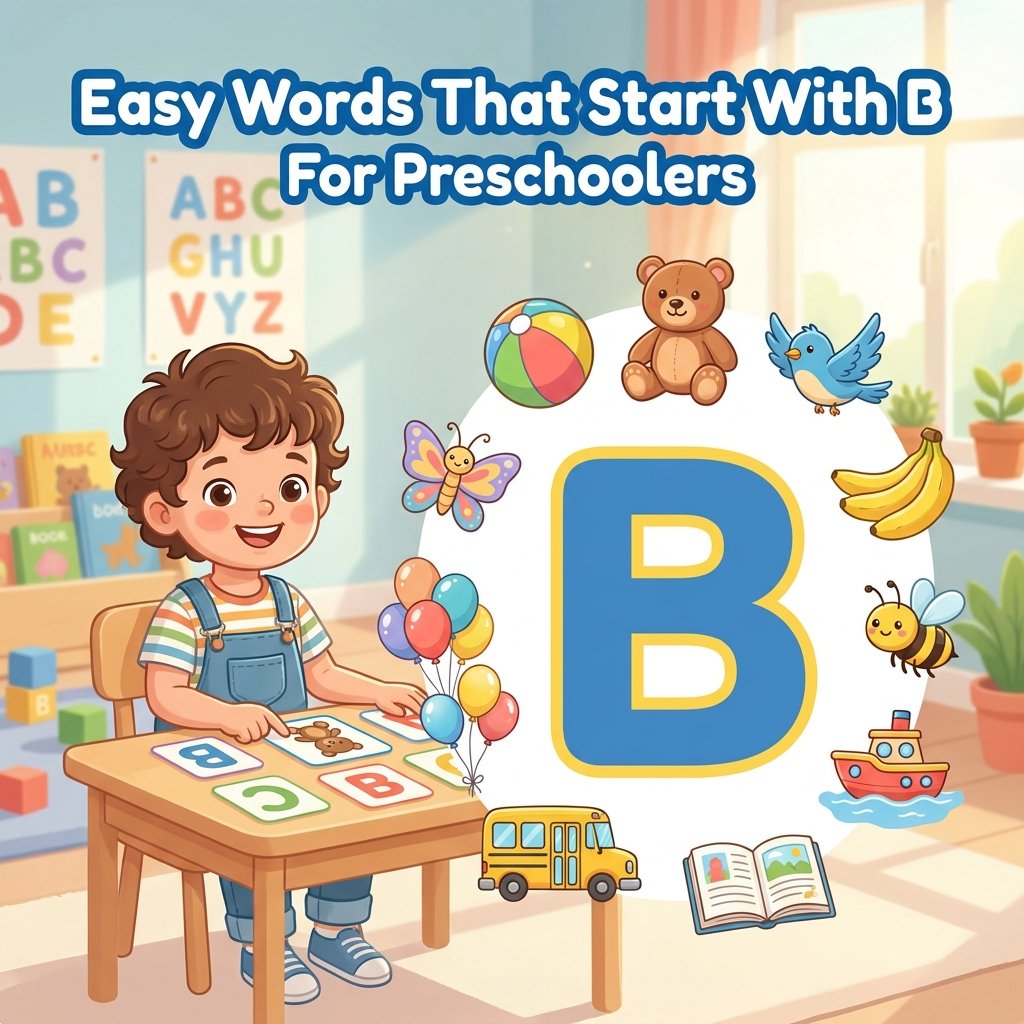
Easy Words That Start With B for Preschoolers 50+
If you’ve ever watched a toddler point out the window and shout “bird!” or “ball!”, you already know how much little ones love the letter B. It shows up everywhere in a preschooler’s world — in favorite toys, snack-time foods, and story books — which makes it one of the easiest and most rewarding letters to teach. This list of words that start with B for preschoolers is organized by category, so whether you’re a parent doing a five-minute activity before bedtime or a teacher planning a full letter-B lesson, you’ll find exactly what you need without wading through one giant, unsorted list.
Below, you’ll find sight words, simple CVC words, and words grouped by everyday objects, animals, food, nature, actions, and describing words — along with practical ways to practice them and a few common mistakes worth avoiding. <!– Image: Toddler pointing at a picture book with B-word illustrations –>
Why the Letter B Is Great for Early Vocabulary
Letter B is one of the first consonants many preschool programs introduce, and there’s a good reason for that. It has a clear, easy-to-produce sound, and it starts an unusually large number of words that toddlers already recognize from daily life — ball, bath, banana, bed. That familiarity gives children an early win: they can connect a sound they’re learning to objects and people they already know and love.
Learning B words also does more than build vocabulary. It helps children practice:
- Sound recognition — hearing the “buh” sound at the start of a word
- Letter-sound association — connecting the shape of the letter B with its sound
- Early blending — combining that beginning sound with the rest of a short word
- Confidence — since B words are so common, kids succeed quickly, which builds motivation for tackling trickier letters later
Because B words are woven into so much of a preschooler’s everyday environment, this letter offers a lot of natural, low-pressure practice opportunities — during snack time, playtime, or a walk outside — rather than requiring flashcard drills alone.
Easy B Sight Words for Preschoolers
Sight words are the small, frequently used words that children are encouraged to recognize instantly, without sounding them out letter by letter. Many of them don’t follow typical phonics rules, so recognizing them “by sight” helps early readers move through simple sentences more smoothly.
Some common B sight words drawn from standard early-reading word lists (like the Dolch and Fry lists used in many preschool and kindergarten classrooms) include:
| Sight Word | Example Sentence |
|---|---|
| be | I want to be a helper today. |
| big | The dog is big. |
| black | My cat is black. |
| blue | The sky is blue. |
| brown | I have brown shoes. |
| but | I like cake, but I like cookies more. |
Sight words matter because young readers can’t sound out every word phonetically yet — some words simply need to be memorized as whole units. Practicing a handful of B sight words alongside simple sentences, as shown above, helps children start recognizing them in books and everyday reading long before they can decode more complex words. Sight-word familiarity is consistently one of the top priorities parents and teachers look for when preparing kids for kindergarten, which is why it’s worth calling these words out separately rather than folding them into a general list. For a deeper look at how sight-word instruction fits into early reading, Reading Rockets offers research-backed guidance for parents and teachers.
Simple CVC Words That Start With B
CVC stands for consonant-vowel-consonant — short, three-letter words like bat or bug that are ideal for teaching kids how to blend sounds together. Because each letter makes a predictable sound, CVC words are usually the first words preschoolers learn to sound out on their own.
| CVC Word | Example Sentence |
|---|---|
| bag | I packed my snack in a bag. |
| bat | The bat flew out at night. |
| bed | It’s time to go to bed. |
| big | That is a big truck. |
| bug | I found a bug on the leaf. |
| bus | We rode the bus to school. |
| box | The toy came in a box. |
How to sound out CVC B-words with your child:
- Say the letter sound “buh” (for B) first, on its own.
- Add the middle vowel sound, then blend it with the B (buh + a = “ba”).
- Add the final consonant sound to complete the word (ba + g = “bag”).
- Repeat the full word a few times, then use it in a short sentence.
This step-by-step blending approach works well because it breaks a skill that feels abstract — reading — into small, repeatable pieces a preschooler can practice in under a minute. <!– Image: Simple flashcards showing CVC words like bat, bag, bug with matching pictures –>
Everyday B Words (Objects & People)
These are the words preschoolers are most likely to already use in daily conversation, which makes them a natural starting point.
- Ball – a round toy you throw, kick, or bounce
- Book – something you read or look at with pictures
- Box – a container, often square, used to hold things
- Bag – something used to carry snacks, toys, or clothes
- Bib – worn to keep a baby’s clothes clean while eating
- Baby – a very young child
- Boy – a young male child
- Brother – a family member, a sibling
Because these words describe people and objects children encounter constantly, they’re some of the easiest to reinforce without any special materials — just narrate what you see during the day (“Can you find your ball?” or “Put the book on the shelf”).
B Animal Words for Kids
Animals are almost always a hit with preschoolers, and the letter B happens to start the names of several classroom and storybook favorites.
- Bear – a large, furry animal often featured in children’s books
- Bird – an animal with feathers and wings that can fly
- Bee – a small, buzzing insect that makes honey
- Bat – a nocturnal animal that flies at night
- Bug – a small insect
- Bunny – a soft, hopping animal, also called a rabbit
Animal words work especially well for movement-based learning — kids can hop like a bunny, buzz like a bee, or flap like a bird while practicing the word, which reinforces the vocabulary through action instead of memorization alone. <!– Image: Cartoon-style illustrations of a bear, bee, bird, and bunny labeled with their names –>
B Food Words for Kids
Food words are useful because they naturally come up at snack time and mealtime, giving children repeated, low-pressure exposure.
- Banana – a yellow fruit that’s soft and easy for little hands to hold
- Bread – a common food often eaten at breakfast or lunch
- Butter – a spread often used on bread or toast
- Berries – small, round fruits like blueberries or strawberries
Try naming these words out loud during snack prep — “We’re having banana and bread today” — so the vocabulary is tied to a real sensory experience.
B Nature and Outdoor Words
Nature words help preschoolers connect vocabulary to the outdoor world, especially during walks, park visits, or backyard play.
- Beach – a sandy area next to the ocean or a lake
- Breeze – a light, gentle wind
- Branch – a part of a tree that grows out from the trunk
- Blossom – a flower, especially one on a tree or plant
These words are a natural fit for a nature walk or garden activity, where children can point to the real thing as you say the word.
Simple B Action (Verb) Words
Action words help preschoolers describe what they — or the people and animals around them — are doing.
- Bounce – to move up and down, like a ball
- Build – to make something by putting pieces together
- Bake – to cook something, like bread or cookies, in an oven
- Blow – to push air out, like blowing bubbles
- Brush – to clean or smooth something, like hair or teeth
Action words are ideal for a quick game of charades: say the word, then act it out together (“Let’s bounce like a ball!”).
Simple B Describing (Adjective) Words
Describing words, or adjectives, help children add detail and expression to their sentences.
- Big – large in size
- Brave – not afraid, willing to try something scary
- Bright – full of light, or very smart
- Bumpy – having an uneven surface
- Blue – a color, like the sky
Adjectives are a bit more abstract than nouns, so it helps to pair them with something concrete your child can see or touch — a bumpy rock, a bright lamp, a blue crayon.
Fun Ways to Practice B Words at Home or in the Classroom
Repetition matters more than any single activity, so the goal is to give children several different, low-pressure ways to encounter the same words.
Letter B Scavenger Hunt
Give your child a simple list (or just call out words) and have them find real objects around the house or classroom that start with B — a ball, a book, a bag, a brush.
Simple B-Word Crafts
Hands-on crafts reinforce the letter shape while reviewing vocabulary. Two easy options:
- Paper bear – cut a bear shape and decorate it while saying “bear starts with B”
- Balloon count – draw or use paper balloons and count them aloud, reinforcing both the word “balloon” and early number skills
Printable Worksheet Ideas
Worksheets are a helpful, low-effort way to reinforce letter B outside of active play:
- Tracing practice – tracing uppercase and lowercase B builds handwriting readiness
- Matching activities – matching a picture (like a ball) to its word
- Coloring pages – coloring pictures of B-word objects while saying the word aloud
Multi-Sensory Tips
Combining movement, sound, and touch tends to help preschoolers retain vocabulary better than sitting still with flashcards alone:
- Sing simple songs that repeat B words
- Use textured letters (sandpaper, felt, or foam) so kids can trace B with their fingers
- Play a sound game where you say a list of words and kids clap only when they hear one that starts with B
For more structured phonics activity ideas, Colorín Colorado has a range of practical suggestions for supporting early readers, including children learning English as a second language. <!– Image: Child tracing a large letter B on a worksheet with crayons nearby –>
Common Mistakes When Teaching Letter B Words
Most word lists stop at “here are some words” — but a few pacing and word-choice mistakes are easy to make and worth flagging.
Moving Too Fast to Blending Before Sound Recognition
It’s tempting to jump straight into sounding out full words like “bat” or “bag.” But if a child hasn’t yet practiced simply hearing and recognizing the “buh” sound on its own, blending can feel overwhelming. Spend time on sound recognition first — games where kids just identify whether a word starts with B — before introducing full blending.
Using Words That Are Too Abstract for Age 3–5
Words like “brilliant” or “belief” may technically start with B, but they’re too conceptual for a preschooler to connect to something real. Sticking to concrete nouns (ball, bear, banana) and simple, visualizable adjectives (big, blue) keeps learning grounded and achievable.
Avoiding these two pitfalls tends to make a bigger difference in how quickly a child gains confidence with letter B than simply adding more words to the list.
NAEYC, a leading authority on early-childhood education, emphasizes matching activities to what children are developmentally ready for at each stage — which is exactly why pacing matters as much as word choice.
Quick Reference: Full List of B Words for Preschoolers
| Category | Words |
|---|---|
| Sight Words | be, big, black, blue, brown, but |
| CVC Words | bag, bat, bed, big, bug, bus, box |
| Everyday Objects & People | ball, book, box, bag, bib, baby, boy, brother |
| Animals | bear, bird, bee, bat, bug, bunny |
| Food | banana, bread, butter, berries |
| Nature | beach, breeze, branch, blossom |
| Actions | bounce, build, bake, blow, brush |
| Describing Words | big, brave, bright, bumpy, blue |
Feel free to print this table and use it as a quick classroom or at-home cheat sheet.
If you enjoyed this letter-based approach to vocabulary, you might also like exploring beautiful places that start with B for an older-kid or family-friendly extension of the “B is for…” theme. And if you’re building out vocabulary lists for older children or classroom word walls, our collections of motivational words that start with M and powerful words that start with P are useful next stops.
Frequently Asked Questions
What are some easy B words for a 3-year-old?
Simple, concrete nouns work best at this age — words like ball, bear, banana, book, and bug. These are objects and animals a 3-year-old likely already recognizes, which makes the letter-sound connection easier to grasp.
What are B sight words for kindergarten?
Common B sight words taught in many kindergarten classrooms include be, big, black, blue, brown, and but. These are frequently used words that children are encouraged to recognize instantly rather than sound out.
How do I teach my preschooler the letter B sound?
Start by practicing the “buh” sound on its own, separate from any full word. Once your child can reliably identify that sound, move on to simple CVC words like “bat” or “bag,” blending the sounds together one step at a time.
What are some B words with pictures for toddlers?
Picture-friendly B words include ball, bear, bird, banana, bus, and book — all concrete objects or animals that are easy to illustrate and recognize in flashcards or picture books.
What is a good “B is for…” theme word for show and tell?
Ball, bear, book, and bug are all popular, easy-to-bring options for a letter-B show and tell, since most households already have something that fits.
How many new words should a preschooler learn at once?
There’s no single fixed number, since it depends on the child’s age and current vocabulary, but many early-learning resources suggest introducing a small, manageable group of words at a time rather than an entire long list at once, so the words can be practiced and retained.
What are some simple B words to use in a sentence?
Short, familiar words work best for early sentence practice — for example, “The ball is big,” “I see a bird,” or “I have a blue bag.
Conclusion
Building a strong vocabulary starts with simple, familiar words, and Easy Words That Start With B for Preschoolers are a fun way to help young learners recognize sounds, expand their language skills, and gain confidence with the alphabet. Whether you’re a parent practicing at home or a teacher planning classroom activities, introducing easy B words through games, books, songs, and everyday conversations makes learning more engaging and memorable.
Keep in mind that every child learns at their own pace. The goal isn’t to memorize a long list of words in one sitting but to create enjoyable learning experiences that encourage curiosity and repeated practice. Even a few new B words each week can make a meaningful difference in a preschooler’s early literacy journey.
As your child becomes more comfortable with the alphabet, exploring words from other letters can help build an even stronger vocabulary foundation. If you’re looking for more alphabet-themed learning ideas, you might also enjoy our guide to Powerful Words That Start With P, which introduces another exciting collection of words to expand young learners’ language skills.